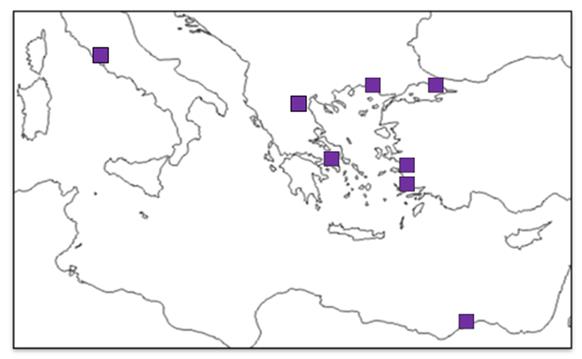
Link the biographical data to the names of eight outstanding women of classical antiquity, make a brief commentary on Agnodice, an important Greek physician of the 4th century BC, and locate on a blank map the places where they were born and where they carried out their activities. They were: Aglaonice, Agnodice, Aspasia, Hipparchia, Hypatia, Metrodora, Theodora and Timarete.
1.- Use the crossword to identify each female character and write her name next to her details.
Across:
3. Originally from Miletus, orator and important figure in the cultural and political life of 5th century BC Athens.
5. Greek cynic philosopher of the 4th century BC born in Maronea (Thrace):
6. Athenian physician of the 4th century BC who studied in Alexandria and worked in Athens dressed as a man:
7. Empress of Byzantium who drafted laws in defence of women's rights:
Down:
1.Philosopher, mathematician and astronomer of the 4th century BC. She was born and worked in Alexandria.
2.Thessalian astronomer of the 2nd or 1st century BC, an expert in predicting lunar eclipses, shared her knowledge with the so-called "Thessalian witches":
4.Physician of Greek origin who worked in Rome in the 1st century AD and wrote a book on women's diseases:

2.- Read this information about Agnodice and give your opinion about the courage of this woman in her choice of profession. Discuss with your peers whether all professions are now equally accessible to men and women.
In Athens there was a law prohibiting women from practising medicine even in the field of gynaecology and obstetrics. Many women, ashamed to be assisted by men in childbirth, lost their lives along with the foetus. Agnodice, sympathetic to this situation and because she had an inclination for medical science (her father was a doctor), decided to study medicine at the school in Alexandria with the famous Hierophilus, dressing herself as a man. When she finished her studies, she began to practise her skills in Athens, but always in disguise. She assisted women in childbirth and other ailments, though secretly declaring to them that she was a woman. The doctors, seeing their profits reduced, accused her in the Areopagus of illicit intimacies with the other gender because they thought she was a man. She displayed herself naked in front of the court to show her womanhood and defend herself, then the doctors used a second, more serious accusation: the law forbade women to use medicine. Agnodice was sentenced to death, but a women's revolt was organised and she was acquitted and the law was repealed.
3.- Write the names of the cities (or regions) that appear in the information on the characters in the corresponding square. Add the name of each woman who is related by birth or activity next to it.