
Abbess Hildegard of Bingen, born in 12th century Germany, was a wise woman who, besides writing about religion, wrote scientific books.
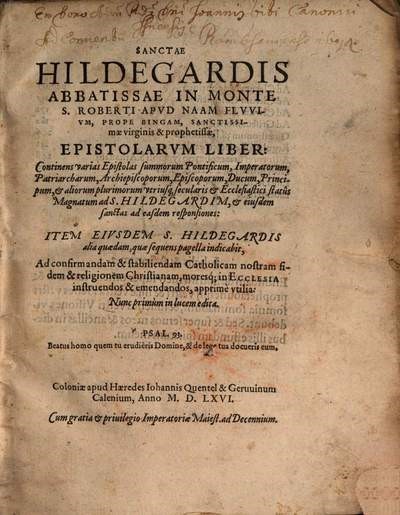
Here is a picture of the cover of the 16th century codex that reproduces Hildegard's correspondence. These letters, just as the rest of her work, are written in Latin. However, it is not the same Latin that the Romans used, but the language of culture and communication during the Middle Ages, much like English is today. For that reason, they had to incorporate some words that didn't exist during Roman times, and some other words had a different meaning. Those words are Ecclesiastic Latin. In Latin dictionaries, they are marked with a little cross.
https://www.europeana.eu/es/item/358/item_BKEHD4BOTYZ3JH3BAB2NWCMCYLQ5WWH3
Sanctae Hildegardis Abbatissae In Monte S. Roberti Apvd Naam Flvvivm, Prope Bingam, sanctissimae virginis & prophetissae, Epistolarvm Liber: Continens varias Epistolas summorum Pontificum, Imperatorum, Patriarcharum, Archiepiscoporum, Episcoporum, Ducum, Principum, & aliorum plurimorum utriusq[ue] secularis & Ecclesiastici status Magnatum ad S. Hildegardim, et eiusdem sanctas ad easdem responsiones; Item Eivsdem S. Hildegardis alia quaedam ...
1- Look up the following words in a Latin dictionary: abbatissa, prophetissa, pontifex, imperator, patriarcha, archiepiscopus, episcopus, ecclesiasticus. Write down their meaning and if they belong to Ecclesiastical Latin, Classical Latin or if they have a different meaning depending on the period.
2- Do some research on the ethymology of the word abbatissa. Then check the meaning of abbot on Wiktionary.
3- Do the same with the words ecclesiasticus and ecclesiastical.
4-Some of these Christian words are incorporated into Latin through Greek translations. The word archiespiscopus, for instance, comes from the Greek arch- (ἀρχή). Think of other words with the same root and look up their meaning.
5-Investigate the name of some of these important figures who exchanged letters with Hildegard to ask for advice.