
Halley's comet, undoubtedly one of the best known, is a comet that orbits around the sun every 76 years. aproximadamente. In 1758, Nicole-Reine Lepaute calculated the exact date of its return to Earth. Predicting that it would return in April 1759. Her prediction was a great success, the comet passed its perihelion (point at which the comet is closest to the Sun) in March 1759 and took its way back. Nicole Lepaute (1723-1788) was a French astronomer considered one of the "best astronomical computers" of the time.
The last sighting of Halley's comet was in 1986, and it has taken scientists much longer to learn more about the nature of the most famous of its kind. We now know that comets are made up of ice and dust. Thanks to this composition, as they approach the Sun, their orbital trajectory causes their components to evaporate, creating their characteristic trail or tail.
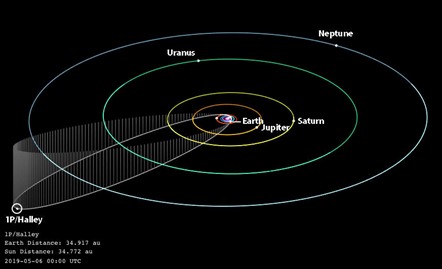
Fuente: https://www.nasa.gov/sites/default/files/styles/full_width/public/thumbnails/image/halleys_comet_4_eta-aquarids-2019-orbit-halley.jpg?itok=Cf2_qJWQ
(consultada 14/02/2022)
In this context, let us now consider the following astronomical problem.
1. Calculate the gravitational force of the sun on the comet when it is in the perihelion of its orbit, 0.6 AU.
2. What will be the force of Halley's comet on the Sun at that point?
Data:
G=6,67·10-11 N· m2/kg2, mass of the sun: 1,989 × 1030 kg , mass of the comet 2,2×10¹⁴ kg
1 UA = 149 597 870 700 m