
Read the following excerpts about Theano of Crotone, Pythagorean philosopher in the 6th century BC and answer the questions.
A- Long did the charms of fair Theano bind the Samian Pythagoras, who laid bare the tortuous mysteries of geometry; who all the mazes of the sphere unfolded, and knew the laws which regulate the world, the atmosphere which doth surround the world.
English translation of Athenaeus of Naucratis. The Deipnosophists, or the Banquet of the Learned, 13.71. Retrieved from Athenaeus. The Deipnosophists. Or Banquet Of The Learned Of Athenaeus. London. Henry G. Bohn, York Street, Covent Garden. 1854.
B- About this dignity [Theano], the following apothegm is said: Having been asked a woman about how many days has a wife to wait since her union to her husband until she can go the temple of Demeter, she answered: "With her own husband at once, with another man never".
Our own translation from: Clement of Alexandria, Stromata. 19, 121.3
1.
Match the items of the columns so that each mathematical concept is related to its Greek or Latin etymon and its corresponding definition: angle, arithmetic, calculus, mathematics, geometry.
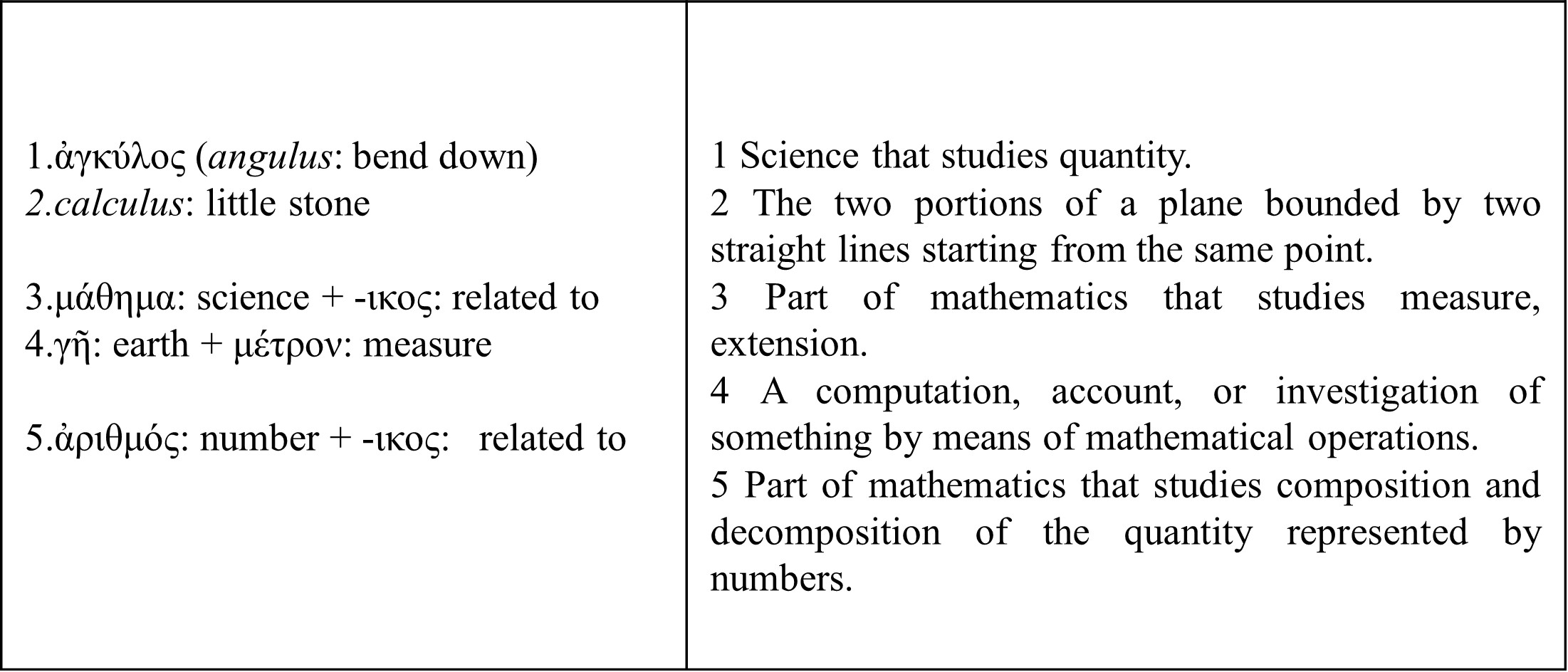
2. From the following Greek etymons (there are two Latin etymons), form compound words. Afterwards, look them up in the dictionary and write their definition:

3. Write the name of polygons and polyhedron with four, five, six, seven, eight, nine, ten, and twelve angles or faces from the Greek numbers: τέτταρες-τέτρα (téttares-tétra) four; πέντε (pénte) five; ἕξ (hex) six; ἑπτά (heptá) seven; ὀκτώ (octó) eight; ἐννέα (ennéa) nine; δέκα (déca) ten; δώδεκα (dódeca) twelve.
4. Match an element of each column so that each mathematical concept is related to their Greek or Latin etymon. Then, explain their meaning.
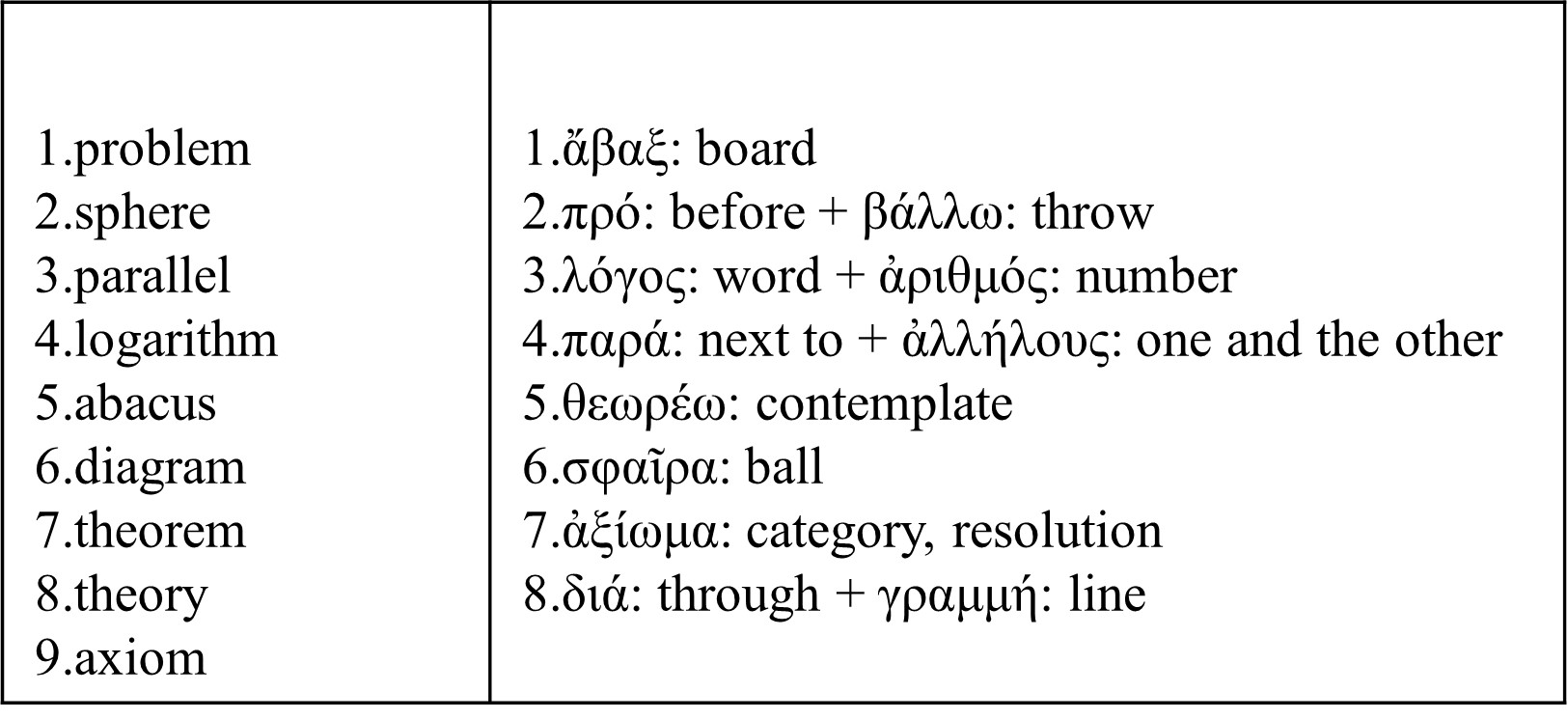
5. There are two etymons, a Greek one, ἴσος, and a Latin one, aequus (equi-), meaning equal. Write compound words and explain their meaning.