
The eyes are organs that enable one of the senses most used by human beings: vision.
These organs have receptors capable of capturing light and sending these light signals to our brain, which integrates them and converts them into images.
As the years go by, our eyes stop working as well as we would like them to, due to various wear and tear factors. The leading Spanish scientist Flora de Pablo has developed a therapy to prevent neurodegeneration of the retina, which could be the key to curative therapies for our eyes. In order to develop this therapy, she founded the company Proretina Therapeutics.
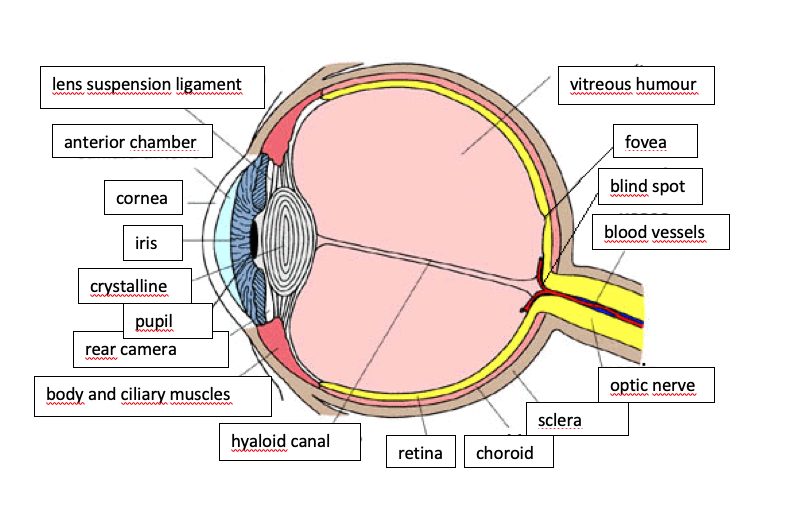
1. Identify the retina in the image and describe the function of this layer of the eye.
2. The technique for maintaining our eyes developed by Flora de Pablo is based on preventing neurodegeneration of the retina: what type of cells do you think will form the retina?
3. Relate the cells you identified in the previous question to one of the systems that form human beings, and reason why neurodegeneration of these cells can be a serious problem.
4. Flora de Pablo's research has been linked to other neurodegenerative diseases that are very important today. Name at least two neurodegenerative diseases that could apply these types of therapies if they were properly developed.
5. Cataracts are also a vision-impairing disease caused by clouding of the lens of the eye. Reason whether the therapy developed by Flora de Pablo could also be a cure for cataracts.