
We are going to carry out a laboratory experiment using the induced heat method, the bain marie, which is very important both in the chemical laboratory and in the kitchen. The bain marie is a method of slowly heating a substance by immersing the container in a larger vessel containing water or another liquid and bringing it to the boiling point. This method of heating substances was invented by one of the great scientists of antiquity, Mary of Alexandria, in the 2nd century BCE. This and her other contributions are still in use in the 21st century.
Let's put it into practice, and observe the changes that occur in a pure substance and measure the variation in its temperature.
1) Take a small amount of ice and place it in a beaker with a thermometer as shown in the figure. Write down the initial temperature.
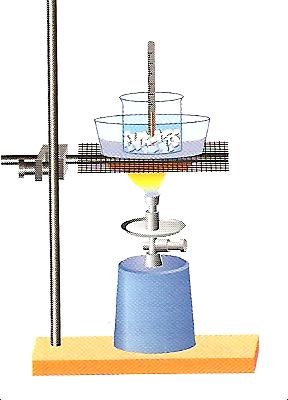
2) Heat in a bain marie (by placing the cup of ice in another container of water) and record the temperature every minute.
3) Fill in a table with the temperature values per minute and the state of the ice: solid (ice), solid-liquid, liquid (water).
|
Time in minutes |
0 |
1 |
2 |
3 |
4 |
5 |
6 |
7 |
8 |
| Temperature (°C) | |||||||||
|
Ice state: solid (ice), solid-liquid, liquid |
4) Answer the following questions:
- What happens to the temperature in the first few minutes before the ice starts to melt?
- What temperature do we record while we have a mixture of ice (solid water) and liquid water?
- What happens to the temperature during the time ice is melting, i.e. becomes liquid (water)?
- What happens to the temperature when there is no more ice in the beaker and we continue heating?
- How is called the temperature at which a substance changes from solid to liquid state
5) Draw conclusions (fill in the dotted lines):
The temperature at which a substance changes from a solid to a liquid state (melting process) is called ................................... and is equal to the solidification temperature (when a substance changes from a liquid to a solid state). For the duration of the change of state, the temperature ..........................................