
You are going to meet the nine poetesses that belong to what it is considered to be the "first feminine literary canon". Antipater of Thessalonica gathered them in an epigram that he supposedly wrote and called them "the nine Muses". Only three of them belong to the Hellenistic period. Aristodama of Smyrna will be added to this list. The activity you are going to complete has two parts.
1- Extract the name of the three Hellenistic poetesses from the epigram, using the information table below, and write them down in your notebook. Then include Aristodama in your list.
EPIGRAM / FIRST "CANON" OF FEMININE POETRY
This epigram is not a catalogue of all Greek female writers, because these poetesses were not the only women to write in Ancient Greece. For this reason, the canon assesses and selects from the catalogue. Just like the heavenly muses were raised at the foot of Mount Helicon, the divine inspiration of these poetesses is the cornerstone that the author uses to claim that they were also fed at Pieria, that is, that they were also muses.
These are the divine-voiced women that were fed with songs,
by Helicon and the Macedonian hill of Pieria:
Praxilla, Moero, the mouth of Anyte, the female Homer,
Sappho, glory of the beautiful, curly-haired Lesbian women,
Erinna, renowned Telesilla, and you Corinna,
who sang the military shield of Athena,
female-tonged Nossis, and sweet-sounding Myrtis,
all craftswomen of eternal pages.
Great Ouranos gave birth to nine Muses, and these nine
Gaia bore, deathless delight for mortals.
(AP IX 26)
Fernández Robbio, Matías Sebastián (2014). «Musas y escritoras: el primer canon de la literatura femenina de la Grecia antigua (AP IX 26)», en Praesentia 15, (retrevied on 05/04/2022)
INFORMATION TABLE
The authors cited lived between the 7th and 3rd centuries BC. None of them was from Athens, they were from distant regions such as Byzantium in ancient Ionia or Locris in Magna Graecia.

ABOUT ARISTODAMA
She was a poetess from ancient Ionia. None of her works have survived to the present; we only know about her because of an inscription in the city of Lamia, in central Greece. Aristodama and her brother Dionysus were granted citizenship and other honours in recognition of their poetic skill. Even though there is not much information about her, it is thought that she was a cultured, travelling woman, and that she had great literary aspirations, far from the ones of the local poets from Archaic Greece.
ABOUT THE THREE HELLENISTIC POETS MENTIONED IN THE EPIGRAM
The three of them belonged to a cultured, bookish circle, typical of the male authors of the time, and they were on equal footing in literary circles usually frequented by men.
2- Following the information from the table, find the places of origin of these poetesses in the map.
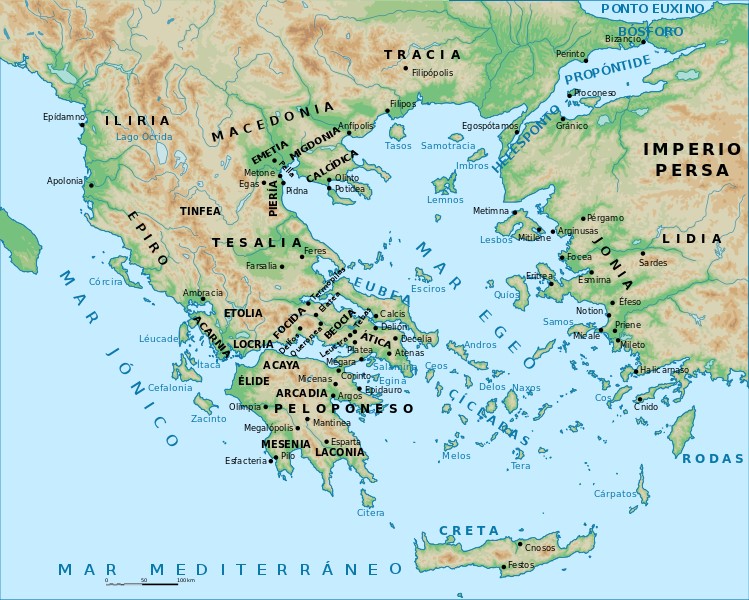
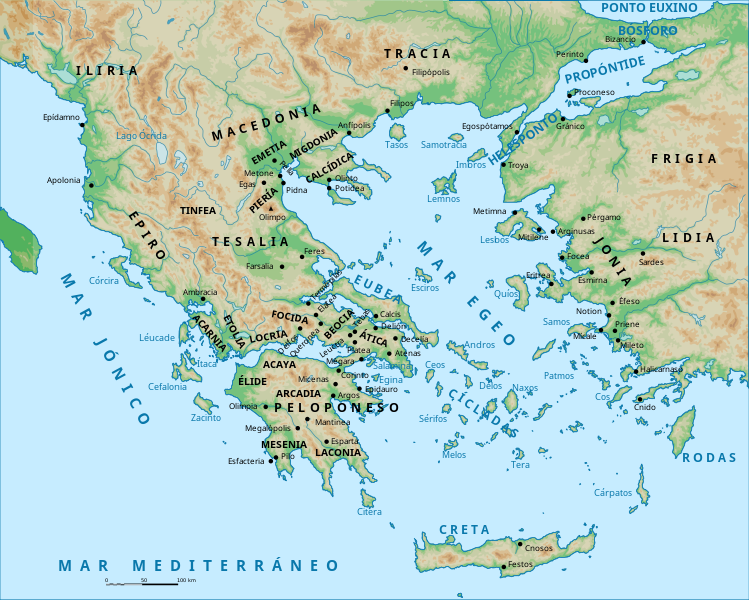

3- Cut out the pictures corresponding to Hellenistic poetesses and stick them on their place in the map. In the case of Aristodama, write her name.

4- Look at the timeline and Answer the questions.

a- Write the name of the four poetesses.
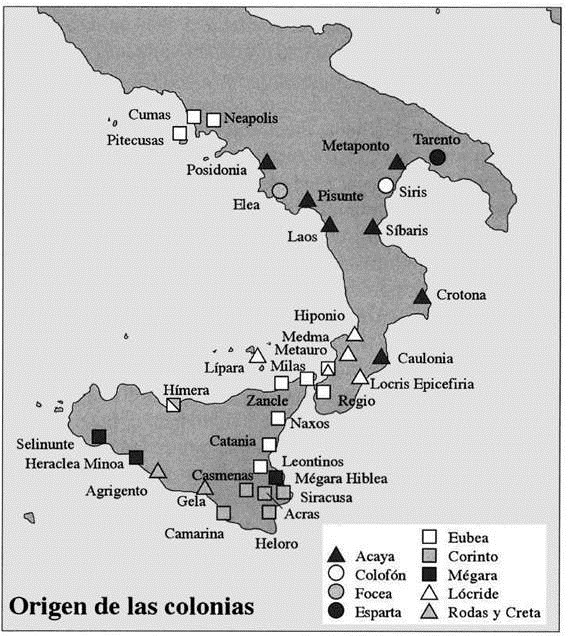
b- What territory does Epizephyrian Locris belong to?
c- Which Greek region founded that colony? Locate it on the map.
d- Why do we include them in the Hellenistic period?
e- Is there any poetess from Athens?
f- Hellenism entailed a cultural, social and political opening. What are the aspects that indicate this?
g- What literary genre do the three poetesses mentioned in the epigram share?