
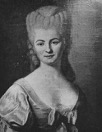
Nicole Lepaute (1723-1788) was a French astronomer considered one of the "best astronomical computers" of the time. In 1758, she made predictions about the return of Halley's Comet and determined how the gravity of the planets can affect the path of a comet. In 1762, she calculated the exact time of a solar eclipse that would occur in 1764 by making a map of the extent of the eclipse throughout Europe, with intervals of 15 minutes.
In this context, let us now consider the following astronomical problem:
Weight is the force with which any object is attracted due to the acceleration of gravity, acting on the mass of the object. According to Newton's second law, we have:
p = m . g
where p is the weight (expressed in Newtons, N); m is the mass (expressed in kilograms, kg) and g is the acceleration due to gravity (which is approximately 9.8 m/s2 on Earth).
On other planets or satellites, the weight of objects varies if the mass of the planets or satellites is different (greater or smaller) than the mass of the Earth.
If the gravity on the Moon is approximately 0.16 times that of the Earth, calculate how much a 5 kg cat and a 1200 kg car would weigh on Earth and on the Moon.