Timarete was born in Athens during the 5th century BC and she was the daughter of Micon of Athens, a painter and sculptor of some works related to the Olympic Games of antiquity. She made a panel painting of the goddess Artemis, which was preserved for many years in the temple of this divinity in Ephesus. The image was taken out during processions in the festivities dedicated to the goddess.
The Artemis of Ephesus is the result of combining that which four other deities represented. Let's see which ones.
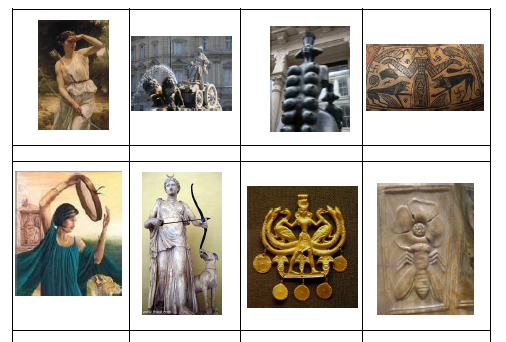
Look at the images.
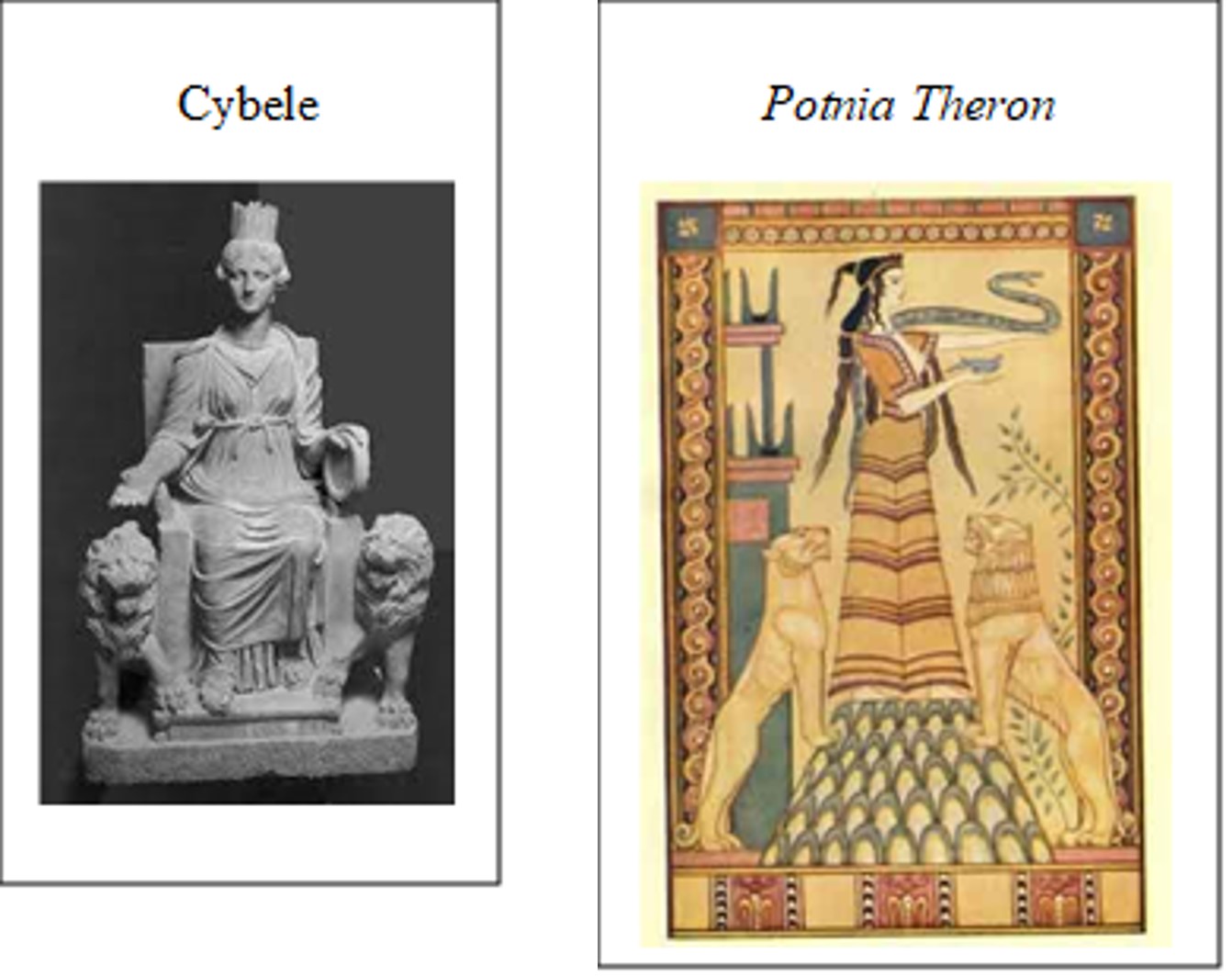
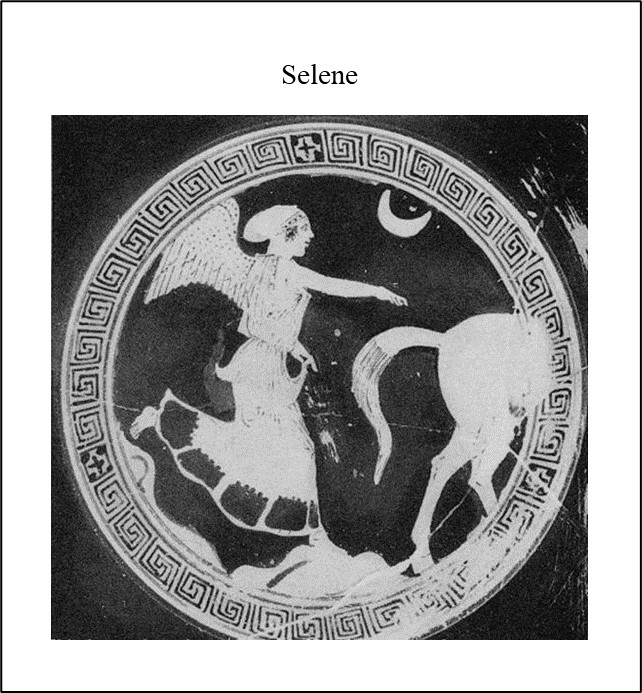
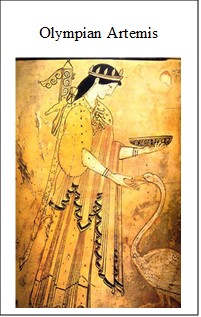
Read about each one of the deities.
Cybele: The origin of the Phrygian Kybele is found in the Pessinus region, in Anatolia (Asia Minor) and dates back long before the birth of Jesus Christ, as she has been worshipped since Neolithic times. She is the goddess of the earth, fertility and rebirth. Originally she was a meteorite, a black stone that was venerated for its celestial origin as the mother of gods, of men and mistress of nature and the entire animal kingdom. Her cult spread along the Mediterranean through the Phrygian sailors and, in Greece, she was identified with Rhea, the mother of gods such as Zeus, Hades and Poseidon, and the Cretan Potnia Theron, "Mistress of animals".
From her Phrygian sanctuary in Pessinus (in present-day Turkey), the goddess was transferred to the Metroon −temple of the Mother Goddess− in Pergamon, where the black stone was venerated until the Second Punic War in the 3rd century BC. Rome was then going through an important crisis, threatened by Hannibal's Carthaginian troops. Faced with this situation, the Romans turned to the Sibylline Books, which gave as a solution looking for the "Cybele Stone". On April 10th, 204 BC, the Magna Mater arrived in Rome and luck changed so much for the Romans that they built a temple on the Palatine in her honor.
She is usually represented with a crown of oak or, sometimes, small towers that symbolize the cities that she protected. She appears seated on a throne, accompanied by at least one lion, or on a chariot pulled by two lions. In her hand she might hold the tympanum −a tambourine−, given the close relationship the goddess has with ritual music.
The positions that this goddess had been holding were already held by other divinities in Western cultures: Rhea and Demeter in Greece; and Ops and Ceres in Rome, all of them associated with the Earth, nurturing mothers par excellence, owners of what is hidden in nature, of the mysterious, of the primordial. Thus, although Cybele maintained her attributions, her identity was diluted, becoming the goddess Rhea in Greece and, in Rome, although to a lesser extent, to her equivalent, the Sabine Ops.
Potnia Theron: Potnia is a female deity associated with the control of the natural world that we find in the eastern Mediterranean since the Bronze Age. Her representations are abundant in Asia Minor (Lydia, Ephesus) and Crete. There are representations of her from the Minoan and Mycenaean era and, although there are earlier representations, she was the most important deity in Greece by the end of the Bronze Age, specifically during the Mycenaean period (1600-1100 AD). She is mentioned on the Knossos and Pylos Linear B tablets as PO-TI-NI-JA, "mistress." In Corfu, worship was paid to a potnia identified with Artemis, who is not the goddess of the Olympian religion, but the same deity that in Arcadia was venerated as the wife of Zeus, mistress of the animal world, who was at the same time the protective goddess of the offspring of the human womb. In Sparta she was identified with Artemis Orthia; in Ephesus, with Opis, a local goddess also called anassa, "sovereign", who became identified with Artemis. According to the sources, Opis was also a fertility goddess, mistress of life, invoked by various names. In The Iliad, the Potnia Theron is a formula applied to Artemis as mistress of the animals, and, by extension, of natural life. The animal that most frequently escorts her is the lion. There are also representations with aquatic birds and deer; with a panther and a deer; with a male goat; or with eagles. Sometimes she also appears with reptiles and rabbits. Finally, in the Greek Olympian religion, the place of Potnia disappeared and her divine qualities were dispersed among many goddesses such as Demeter, Artemis, Athena and Persephone.
Olympian Artemis: In Greek mythology, Artemis was one of the most worshipped deities, one of the oldest. She is the Greek goddess of the hunt, wild animals, virgin land, births, virginity, and maidens the one who brought and relieved women's illnesses.
She was often depicted as a huntress carrying a bow and arrows. The stag and the cypress were sacred to her. In The Iliad, she is referred to as Artemis Agrotera, Potnia Theron, "Wild Artemis" and "Mistress of the Animals".
The figure of Artemis even assumed the role of Ilithyia, goddess of birth, as an assistant to childbirth, and ended up being identified with Selene, a titan who was the Greek goddess of the Moon (which is why she is sometimes represented with a moon growing above her head). She was also identified with the Roman goddess Diana and the Greek Hecate, goddess of crossroads.
Selene: She was the titan who personified the moon, daughter of the titans Hyperion and Tea. Her equivalent in Roman mythology was the goddess Luna. She ended up being identified with Artemis, just as her brother, Helios −the Sun−, was identified with Apollo, brother of Artemis.
Answer:
- What do the goddesses Cybele, the Mistress of the beasts, and Artemis have in common?
- With which Greek goddess was the Mistress of the beasts identified?
In Ephesus, the primitive goddess Opis had been identified with the Phrygian Cybele and, when the Ionians settled in that territory, they in turn identified this goddess with the Greek one who most resembled her. Thus, they gave her the name Artemis, and aspects of the Greek Artemis were attributed to her, such as identification with the moon.
Answer:
- What was Opis goddess of?
- Why did the Ionians identify Opis with Artemis?
Looks at the pictures representing Artemis of Ephesus.
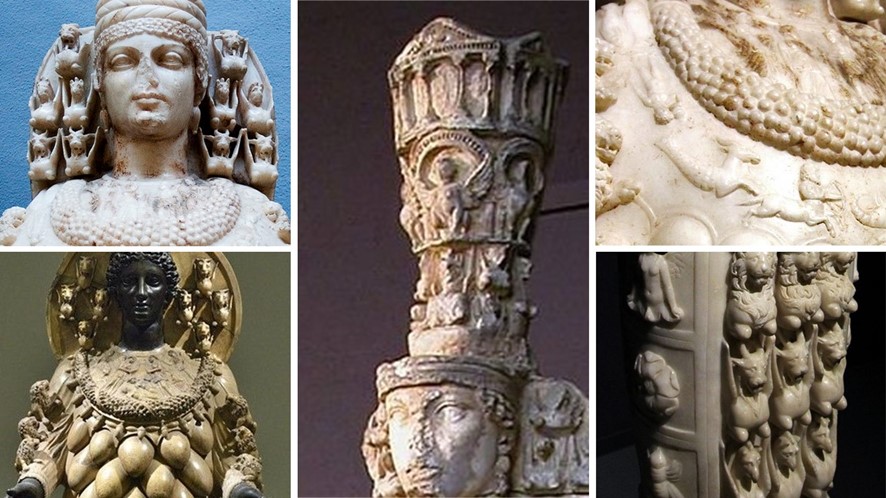
Answer:
- Point out what attributes of the goddess identify her with Olympian Artemis. Give reasons for your answer.
Now that you know the attributes of Cybele, Potnia Theron, Efesian Artemis and Olympian Artemis, identify them in the following pictures.