Erina was a Greek poet of the 4th century BC, whose most famous work contains 26 legible verses, out of a total of 54, corresponding to different parts of the poem. Originally, this poem, called The Distaff, was 300 lines long. It is a lament for the death of her friend Baucis and an evocation of a childhood lost and spent with her. She was born on the island of Telos, now Tilos, in Greece, near Kos, where she seems to have studied. She was much admired in her time and praised by later poets for the maturity of her writing despite her young age, as it seems she wrote this poem at the age of 15.
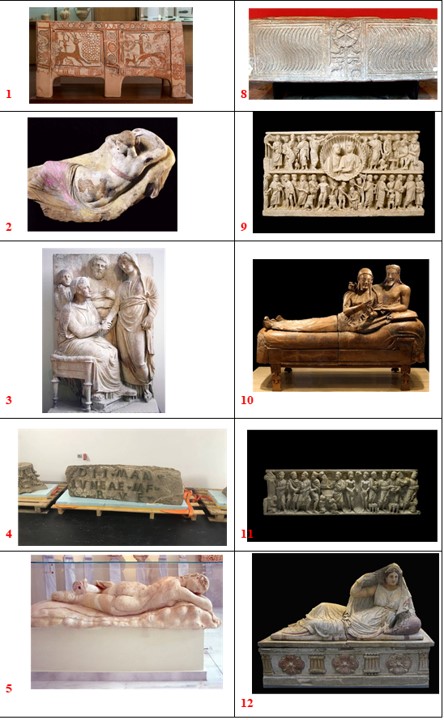
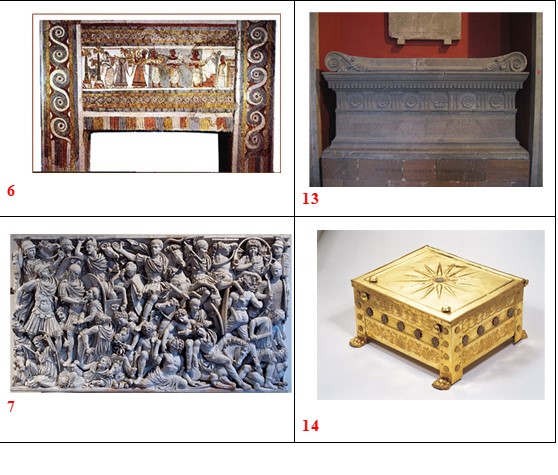
The Palatine Anthology attributes to Erinna some epitaphs dedicated to her friend Baucis, such as the one listed below. In this activity, you are proposed to compare tombs belonging to different civilizations and periods, starting with the Etruscans, going through the Greeks and the Romans, and reaching the paleochristian period.
EPITAPH from the tomb of Baucis (Erinna, AP 7.712)
I am the tomb of Baucis, a young bride, and passing by
the much-lamented grave, over the earth, you say this to Hades;
“You are malicious, Hades” and to you, seeing these
beautiful letters, they will tell of the most-cruel fate of Baucis
how her father-in-law lit the girl upon her funeral pyre
with the pine torches, those over which Hymen sang
and you, oh Hymen, you changed the tuneful song of
marriage into the mournful wail of a funeral.
Barclay, Julia (undated). "The honeycomb of Erinna: an examination of homoerotic love, loss, and lamentation" (retrevied on 02/06/2023) <https://journal.lib.uoguelph.ca/index.php/classics/article/download/6320/6000/31631>
Epitaphs were also common in Rome, although they were not in the same style as the Greek ones. Here are some examples of Roman tomb epitaphs. Note that they range from the simplest formulas to the invocation of the protective gods of the deceased person or the description of their achievements in life:
1- Sit terra levis (S.T.L.)
2- Requiescat in pace (R.I.P.)
3- Epitaph of Lucius Cornelius Scipio Barbatus:
CORNELIVS·LVCIVS·SCIPIO·BARBATVS·GNAIVOD·PATRE
PROGNATVS·FORTIS·VIR·SAPIENSQVE—QVOIVS·FORMA·VIRTVTEI·PARISVMA
FVIT—CONSOL CENSOR·AIDILIS·QVEI·FVIT·APVD·VOS—TAVRASIA·CISAVNA
SAMNIO·CEPIT—SVBIGIT·OMNE·LOVCANA·OPSIDESQVE·ABDOVCIT
«Cornelius Lucius Scipio Barbatus, born of his father Gnaeus, was a strong and wise man, whose appereance guarded his many virtues, who was a consul, censor and magistrate among you. He conquered Taurasia, Cisauna, Sambio and subjugated Lucania and freed their prisoners.»
4- Epitaph from the tomb of Junia Rufina found in Baelo Claudia (Cádiz): «To the Manes gods of Junia Rufina, daughter of Marcus»
In Etruria, on the other hand, it seems, based on the archaeological remains found, that it was not customary to include an epitaph, perhaps due to its form of burial inside large sepulchral chambers, which imitated a house, whose walls were profusely decorated with frescoes. Their tombs also had the effigy of the person or people buried in relaxed postures that imitated attendance at a banquet.
Regarding the first Christians, their tombs went through several stages −as, on the other hand, also the Greek ones− and in their tombs we can find symbols of Christianity −such as the Chi Rho, the fish or the good shepherd, among others− in the first centuries (2nd to 3rd century AD)- Biblical or mythological scenes can also be found, reconverted into Christian allegory, in the later ones (4th century AD).
Look at the images of these tombs and try to classify them, according to the Greek, Etruscan, Roman or paleochristian period. Give reasons for your answer.