
Egeria was an upper class lady from the Hispanic province of Gallaecia who made a trip to the Holy Land between 381-384 AD, where she collected her experiences in the book Itinerarium ad Loca Sancta, written in the form of letters.
In this activity we are going to imagine what would have happened if Egeria had traveled through her own country, that is, Hispania. Despite speaking Latin, like the rest of the inhabitants of the Iberian Peninsula, would she have had any communication problems? The Latin that Egeria spoke was the popular variant, with expressions of the spoken language, a trait that characterized the entire population, given that the Latin that entered the Peninsula was the colloquial language spoken by the soldiers and the townspeople.
The Peninsula maintained the territorial distribution that Emperor Diocletian settled in the 3rd century AD.
1- Look at the distribution by provinces on the map.
2- List the different provinces with their capital cities.
3- Read the text.
4- Answer the questions.
5- Place on the map the name of the provinces and their capital cities and the Romance language that emerged in each of them.
1-Territorial distribution of Diocletian.
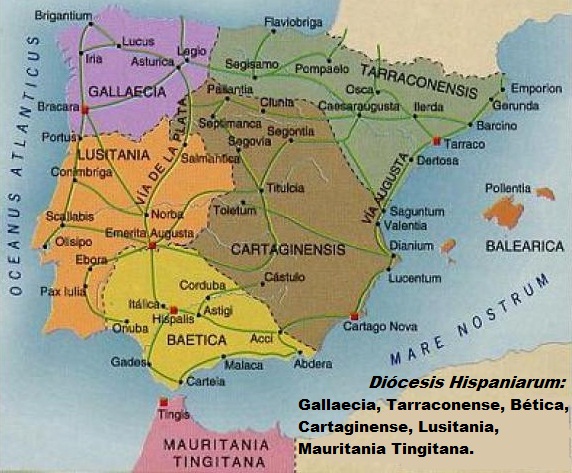
https://truttafario.files.wordpress.com/2013/06/capitales-de-hispania-con-diocleciano.jpg

2- List the provinces and their capital cities.
3- Read the text.
"When the Romans arrived in 218 BC in the North of the Iberian Peninsula, the language that we know as Basque today was spoken. Therefore, this language does not come from Latin.
In Andalusia there were the Tartessians, and the Iberians were in Levante. In this area, at various times, the Etruscans, of Italian origin, left their traces; and also the Phoenicians (Gadir, Cádiz); the Carthaginians (Cartago Nova, Cartagena); and the Greeks, who named the Peninsula “Iberia” (Lucentum, Alicante).
In the Center and Northwest of the Peninsula we find the linguistic presence of: the Ligurians, people from the Franco-Italian Mediterranean coast, (Toledo); the Celts, who arrived from the south of Germany towards the 7th century BC and occupied the high regions from the center to Galicia and southern Portugal (Segovia); the Celtiberians in the Center and Lower Aragón, where the speech of the two peoples is mixed. All these languages left their mark on Spanish and the rest of the constitutional languages.
Our own translation from «Historia de la lengua española. Parte I», (retrieved on 19/09/2021), <https://www.csub.edu/modlang/department/spanish/LINGUISTICS/TEMA%207.1%20MA.pdf>
4- Answer the questions:
a- What are the Romance languages of Hispania?
b- Where is each one spoken?
c- How would you define a Romance language?
d- Why has each language evolved in a certain way?
e- Do the different Romance languages have anything in common?
f- Is there any non-Romance language in the Peninsula?
g- What languages were spoken in the Peninsula before the arrival of the Romans?
h- Do a little research and answer: What century do the first written manifestations in the Romance language date from?
5- Place on the map the name of the provinces and their capital cities and the Romance language that emerged in each of them.
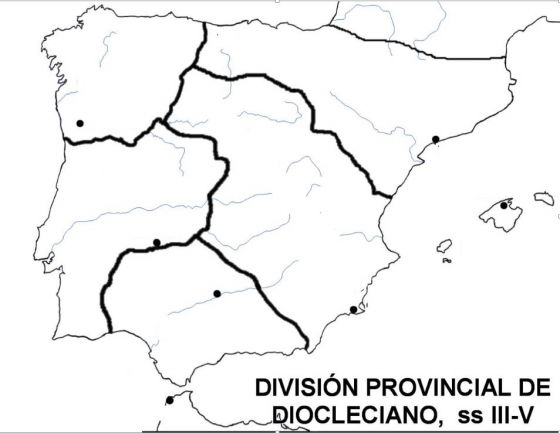
https://cloud.educaplay.com/recursos/42/1354014/imagen_1.jpg
