Magna Graecia
Personajes:
Tema: Magna Graecia
Competencias
Competencia en Comunicación Lingüística
Competencia Personal, social y de aprender a aprender
Competencia en conciencia y expresiones culturales
Materias y cursos por Sistema Educativo
España > Cultura Clásica > 2º ESO > Raíces clásicas del mundo actual. Marco geográfico de Grecia y Roma
Enunciado

Although ancient philosophy has been traditionally presented as a purely masculine world, almost all philosophical schools accepted women. The Pythagorean school, located in the city of Crotone, was one of the first one to do so. Crotone was a city in southern Italy, located in the territory known as Magna Graecia, and the philosopher Theano was from that city.
1- Find out what Magna Graecia is, what its territory was, and why it was considered part of the Greek geographical area.
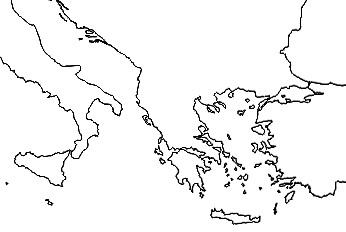
2- Surfing on the internet, in the following blank map, locate the city of Crotone and some of the most important cities in the area: Sybaris, Taranto, Neapolis, Cumae, Elea, Syracuse, Agrigento, Messina, and Gela. Locate the following elements too: Gulf of Taranto, Adriatic Sea, Tyrrhenian Sea, Sicily, Apulia.
3- Members of the Pythagorean school of Crotone lived in a community, so women were fully included and participated in the activities. We know lots of their names, but the most famous one was, undoubtedly, Theano, philosopher of the school who even got married with Pythagoras.
Theano was from Crotone, as well as other philosophers like Phintys. However, other women arrived in Crotone to take part in the Pythagorean community, such as Melissa of Samos; Beo of Argos; Perictione of Athens, Tymicha of Sparta, Habrotelia of Taranto; Equecratia of Phlius; Tirsenis of Sybaris... Locate in a map their home cities and link them with an arrow to Crotone so as to visualise the force of attraction that the Pythagorean school exerted on women from all over Greece.
https://cerebriti.b-cdn.net/uploads/31dcddbc7283782ce6254324e0fcc1a6.jpg
Observaciones y contexto
Crotone was in Theanus' time a colony of Magna Graecia.
Enheduanna (25th century BC) was a predecessor of Theano of Crotone. She is considered to be the first woman in the history of science and the first one to sign her work, in cuneiform; as well the Egyptian physician Peseshet or the Assyrian perfumers like Taputti, who paved the way for later women.
Some of Theano's contemporaries are other women in the Pythagorean school that were born around 500 BC, such as Damo, Myia and Arignote of Crotona, considered to be daughters of Theano and Pythagoras by several authors. Even though there is not much information about them, some other women belonging to this group were Babelica of Argos, Beo of Argos, Quilonis, Equecratia de Fliunte, Ecelo and Ocelo of Lucania, Habrotelia of Tarento, Cleecma, Cratesiclea, Lastenia of Arcadia, Pisirroda of Tarento, Fintis, Teadusa, Timica and Tirsenis of Sibaris.
Following Theano, we can find Aglaonice (3rd century BC, known for her ability to predict eclipses) and Hypatia (4th century AD).
The activity has been assigned to 2nd of ESO, specifically related to the content block Classical roots of today's world. Geographical framework of Greece and Rome, even though it can be carried out in other years.
Descripción
The territory of Magna Graecia is studied through the character of Theano of Crotone, from the south of Sicily. Geographical location of the places of origin of some women philosophers.