Nuclear reactions on stars
Personajes:
Tema: Athom structure
Competencias
Competencia en Comunicación Lingüística
Competencia Matemática, en ciencia, tecnología e ingeniería
Competencia Ciudadana
Materias y cursos por Sistema Educativo
España > Física y Química > 4º ESO > La materia
Enunciado

Read the following text and answer the questions that are posed below:
The energy of stars, and therefore of the Sun, comes from nuclear reactions that take place in their interior.
In 1925, the astronomer Cecilia Payne demonstrated that the predominant components of a star are primarily 11H and 42He in smaller proportions, which means that inside the star there is a true factory of atoms.
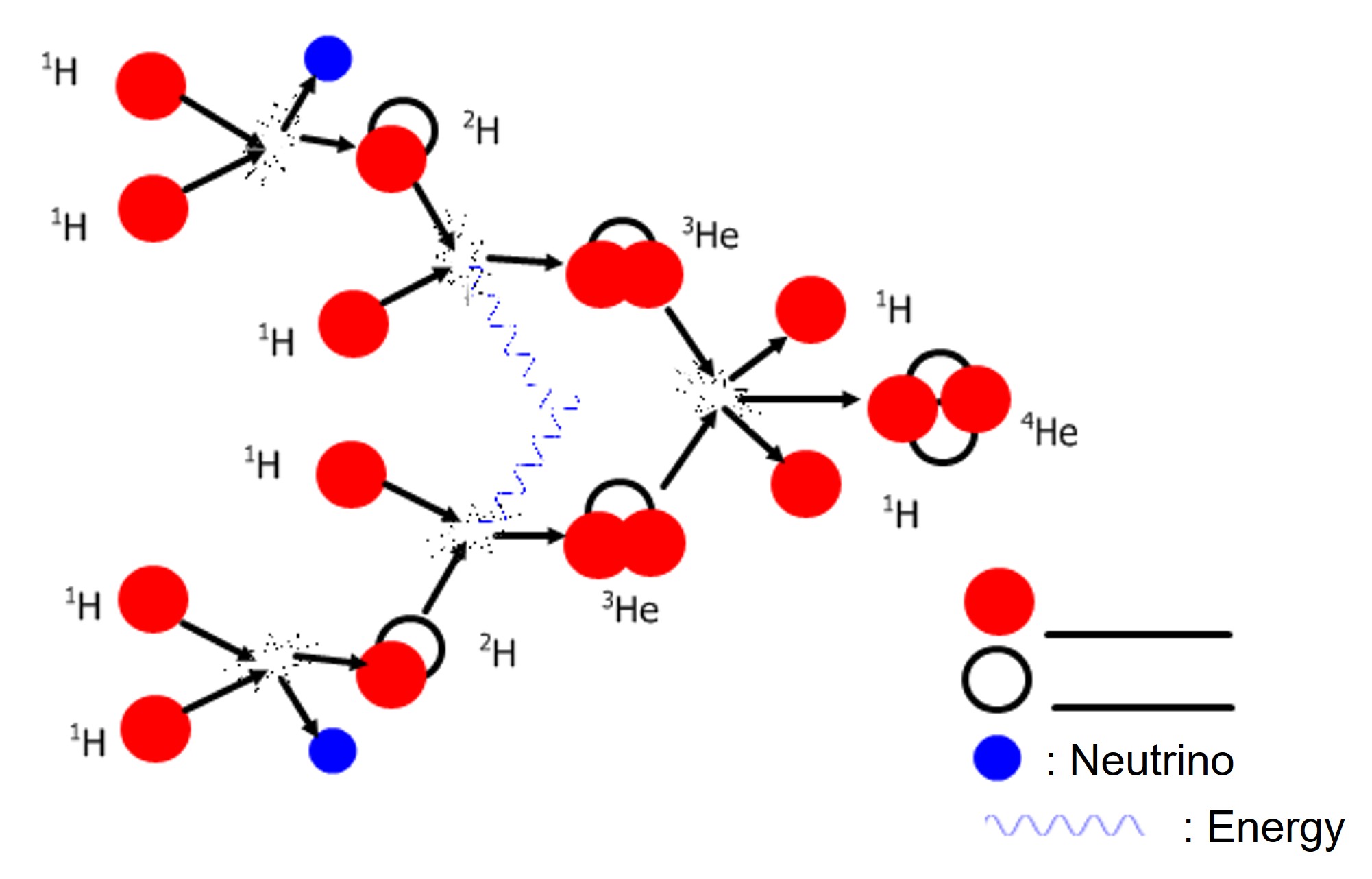
The nucleus of a hydrogen atom consists of a single particle, the proton. The fusion of two hydrogen nuclei results in a deuterium nucleus, 21H , which is an isotope of hydrogen. When deuterium fuses with another hydrogen nucleus, it forms an isotope of helium with mass number 3. Then two helium-3 nuclei collide and form an ordinary helium nucleus 42He.
After the formation of helium, the process of nuclear transformations continues with the successive creation of other elements heavier than helium, such as: 74Be, 73Li and continues up to carbon, nitrogen, oxygen, etc.
(Adapted from the text proposed as a teacher's resource from Editorial Santillana -Proyecto La Casa del Saber, for 3rd ESO).
1) What does the phrase "inside a star, there is a true factory of atoms" mean?
2) In the diagram, indicate the name of the particles represented as:

3) The text describes the following nuclear reaction: “ When deuterium fuses with another hydrogen nucleus, it forms an isotope of helium of mass number 3”.Circle the graphical representation where the process described in the previous sentence takes place.
5) Look at the nucleus in the figure below and indicate: to which element it corresponds, what is its mass and atomic number and write the symbol of the isotope.

6) Explain what is the composition of the nuclei represented by the symbols 11H and 42He.
7) Are atoms 74Be and 73Li isotopes and why?
8) Indicate which of the following symbols are wrong: 42Li , 32H, 31H, 83Li.
9) How are the reactions described in the text called?
Observaciones y contexto
Her work is a continuation of the efforts of a long list of women who dedicated their lives to calculating the trajectories of celestial bodies, such as Hypatia (c. 370-c. 416), Sophia Brahe (1556-1643), Maria Cunitz (1610-1664), Nicole Lepaute (1723-1788), Caroline Herschel (1750-1848), an astronomer who discovered eight comets, and Henrietta Swan Leavitt (1868-1921), an astronomer from USA who was part of the so-called Harvard Computers. This group of women made significant advances in the classification of astronomical data at the "Harvard Observatory" from 1877 to 1919, led by Charles Pickering (1846-1919). Among these women were Williamina Fleming (1857-1911), Annie Jump Cannon (1863-1941), and Antonia Maury (1866-1952).
Some contemporary scientists include Marietta Blau (1894-1970), mathematicians Emmy Noether (1882-1935) and Hilda Geiringer (1893-1973), Nobel Laureate in Physics Marie Goeppert-Mayer (1906-1972), physicist Chien-Shiung Wu from USA (1912-1997), born in China and an expert in radioactivity, and Rosalind Elsie Franklin (1920-1958), a British chemist and crystallographer whose work was essential in understanding the molecular structures of DNA, RNA, viruses, carbon, and graphite.
Other contemporary astronomers of Cecilia Payne include: Vera Rubin (1928-2016), Ida Noddack (1896-1978), Margaret Harwood (1885-1979), Joan Feynman (1927-2020), Maria Assumpció Català i Poch (1925-2009), Antonia Ferrín Moreira (1914-2009), Francesca Figueras (1958), Sandra Moore Faber (1944), physicist and doctor in astronomy dedicated to the study of galaxy formation and evolution; Margaret Burbidge (1919-2020), Nancy Grace Roman (1925-2018), and Maud Worcester Makemson (1891-1977), an expert in archaeoastronomy who directed the Vassar College Observatory from 1936 to 1957, and Martha Stahr Carpenter (1920-2013), the only female professor at Cornell University and an expert in galaxy dynamics.
Cecilia Payne-Gaposchkin served as a role model for other astronomers such as Joan Feynman.
Descripción
Based on the comprehensive reading of a text about the fusion reactions occurring in stars, questions are posed about these reactions using a graphic scheme to aid in their understanding.