The Nine Muses
Personatges:
Tema: Main Olympian gods and goddesses: The Muses
Competències
Competència en Comunicació Lingüística
Competència personal, social i aprendre a aprendre
Competència en consciència i expressions culturals
Matèries i cursos per Sistema Educatiu
Espanya > Cultura Clàssica > 1r ESO > Continuïtat del patrimoni cultural. Mitologia i religió
Enunciat

Corina of Tanagra was a well-known Greek poet. Her simple style, her great erudition in mythology and her taste for local themes won her the admiration of many of her contemporaries. It is even said that she advised and won, in a poetic competition, Pindar, one of the most famous poets of ancient Greece.
Unfortunately, most of his work has not survived to the present day and we do not have any complete poems. One of the fragments found mentions the Muse Terpsichore. Thanks to this mention, you will learn about the sphere of action of the Muses and their artistic representations in iconography.
1. Read the following extract and underline the name of the Muse that appears:
Fragment 1 (PMG 655)
Terpsichore calls upon me
to sing good tales
for the white-robed women of Tanagra,
and the city delights greatly
in my clear, beguiling voice.
for whatever ... great ...
false ...
... land of wide dancing-places
adorning the tales of my ancestors
with my own [?] ...
for maidens ...
... I ... often celebrating Father Cephisus
with my words,
often mighty Orion
and his fifty powerful sons,
whom, in union with the nymphs
and lovely Libya he conceived,
...
the maiden ... I shall tell ...
fair to see
earth whom ... conceived
... begat ...
KlincK, Anne L. (2008), "Corinna", in Woman's Songs in Ancient Greece, Montreal, Quebec: McGill-Queen's University Press, (retrieved on 28/05/2023) <https://www.jstor.org/stable/j.ctt8137f.11>
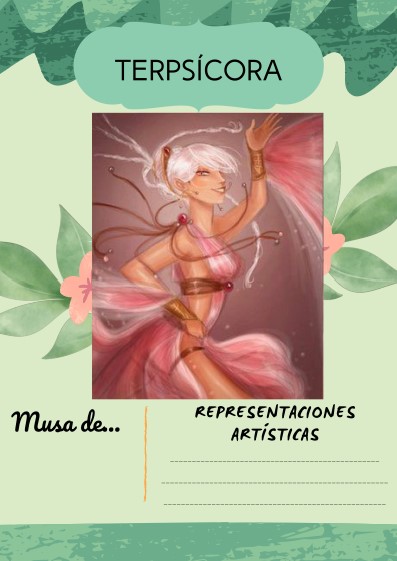
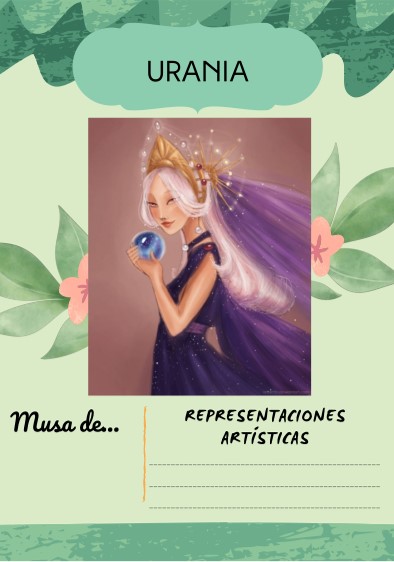
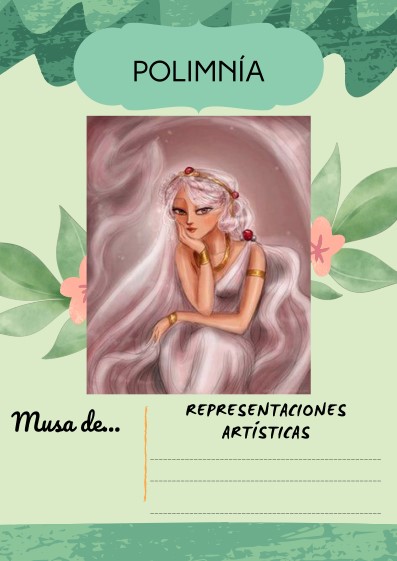
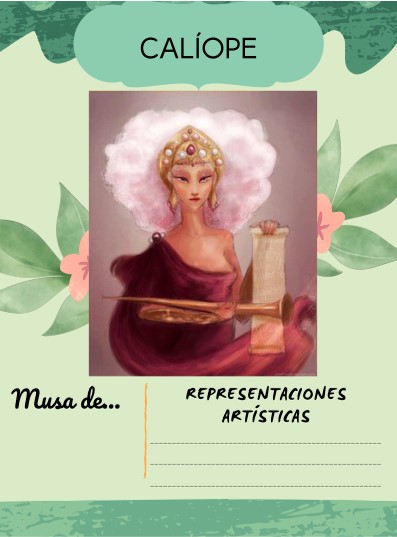
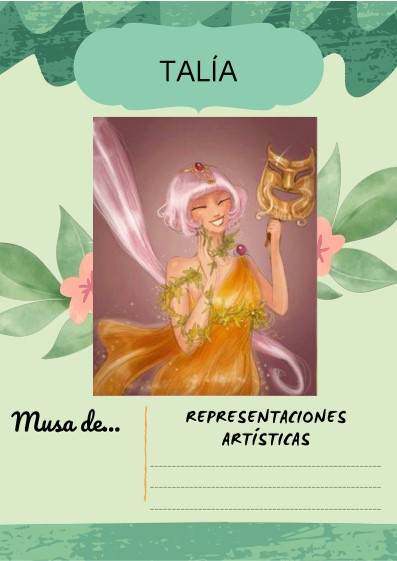
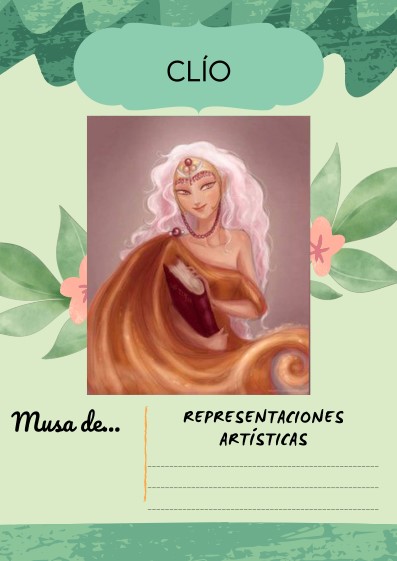
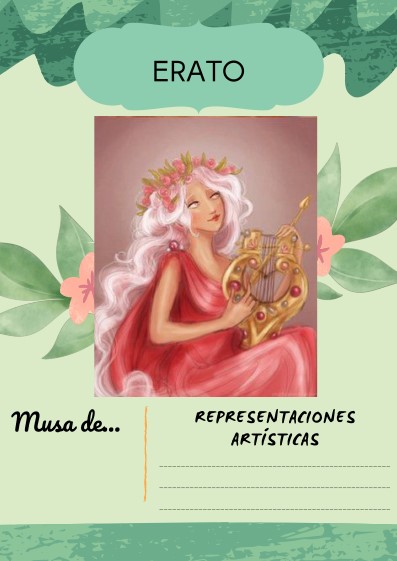
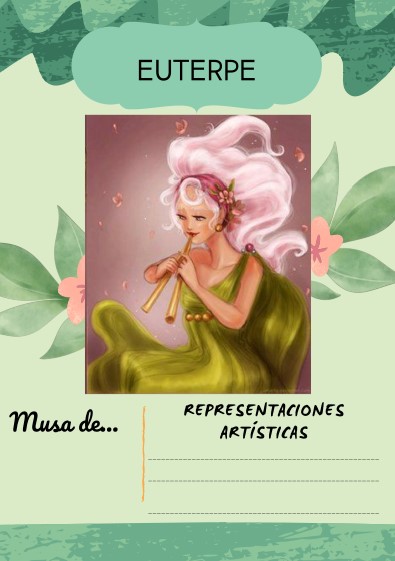
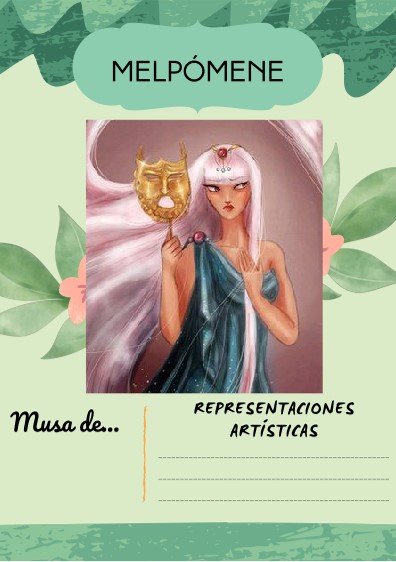
2. Fill in the card for each Muse, saying what she is a Muse of (her sphere of action) and how she is usually represented in art.
Observacions i context
Corina is one of a large but little-known group of Greek poets. She is said to have been a disciple of the poet Mirtis and to have rivalled Pindar himself. Although the local character of her work prevented it from being widely disseminated at first, interest in Corina and her poetry revived at the end of Hellenism. The Greek poet Antipater of Thessalonica (1st century BC) included her in one of his epigrams as one of the nine muses of ancient lyric poetry, among those he considered to be of the highest quality.
We photocopied, for group reading, the author's Fragment 1 (PMG 655) where she mentions one of the Nine Muses.
We briefly explain the mythological origin of the Muses, being daughters of the god Zeus and Mnemosyne and, based on the preserved fragment, students will fill in the Muses' cards with the scope of their power and their artistic representation, i.e. the attributes that accompany them and identify them with the arts they represent. To carry out the activity, students will be given 9 cards.
This activity has been assigned to 1st ESO but can also be done in other grades.
Descripció
Reading of extracts, data collection, reflection, search for information.