We are musivarians
Characters:
Theme: The Roman mosaic
Competencies
Competence in Linguistic Communication
Personal, social and learning to learn competence
Competence in cultural awareness and expressions
Subjects and year by Educational System
Spain > Classical culture > 2nd ESO > Continuity of cultural heritage. Literature, art and science
Enunciation

Corinna of Tanagra was a well-known Greek poetess. Her simple style, her great erudition in matters of mythology and her taste for local subjects helped her earn the admiration of many of her contemporaries. It is even said that, in a poetic competition, she advised and won Pindar, one of the most famous poets of ancient Greece.
Unfortunately, most of her work has not survived to this day and we do not have any complete poems. One of the fragments found alludes to the Muse Terpsichora and the tanagers.
I. Collective reading of the fragment. Identifying the Muses.
Fragment 1 (PMG 655)
Terpsichore calls upon me
to sing good tales
for the white-robed women of Tanagra,
and the city delights greatly
in my clear, beguiling voice.
for whatever ... great ...
false ...
... land of wide dancing-places
adorning the tales of my ancestors
with my own [?] ...
for maidens ...
... I ... often celebrating Father Cephisus
with my words,
often mighty Orion
and his fifty powerful sons,
whom, in union with the nymphs
and lovely Libya he conceived,
...
the maiden ... I shall tell ...
fair to see
earth whom ... conceived
... begat ...
KlincK, Anne L. (2008), "Corinna", in Woman's Songs in Ancient Greece, Montreal, Quebec: McGill-Queen's University Press, (retrieved on 28/05/2023) <https://www.jstor.org/stable/j.ctt8137f.11>
II. 2. We are musivarians.
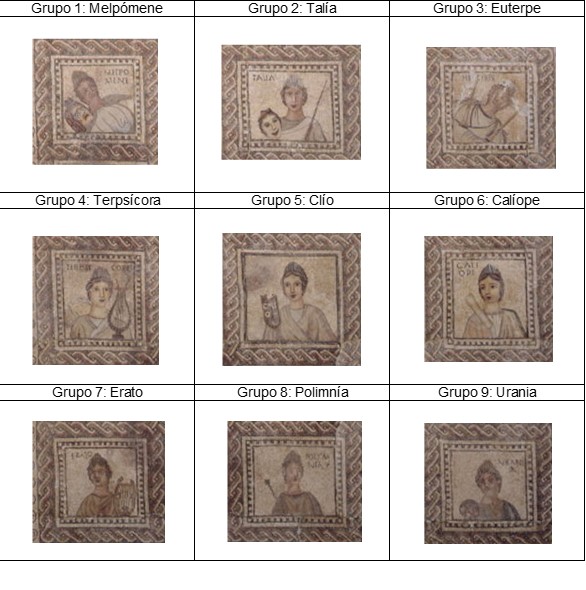
On the board handed out by the teacher, your group has to make a mosaic with the assigned Muse. To do this, you will organize the work as follows:
1- Cut the plasticine into small tesserae and group them by colour.
2- Draw the sketch of your Muse on the wooden board.
3- Paste the tesserae with glue until the mosaic is finished.
4- Once finished, give it a coat of varnish to make it compact and shiny.
5- We will gather all the mosaics and imitate the one found in Moncada, to expose ours in the classroom.
Observations and context
Corinna is part of the extensive but poorly known group of Greek poetesses. She is said to have been a disciple of the poetess Myrtis and to have rivaled Pindar himself. Although the local nature of her work prevented it from being widely disseminated at first, interest in Corinna and her poetry resurfaced at the end of Hellenism. The Greek poet Antipater of Thessalonica (1st century BC) included her in one of his epigrams as one of the Nine Muses of ancient lyric poetry, among which were, in his opinion, those of the highest quality.
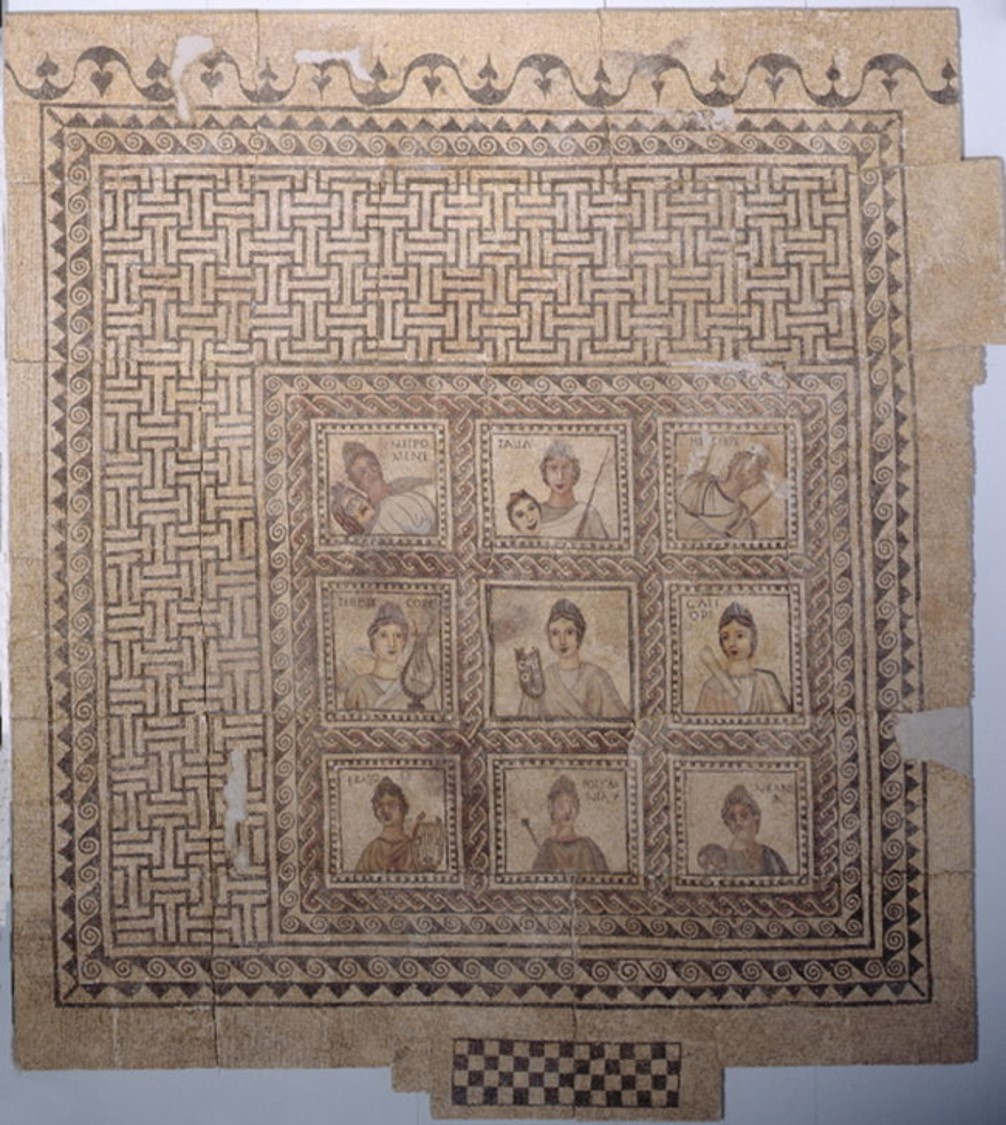
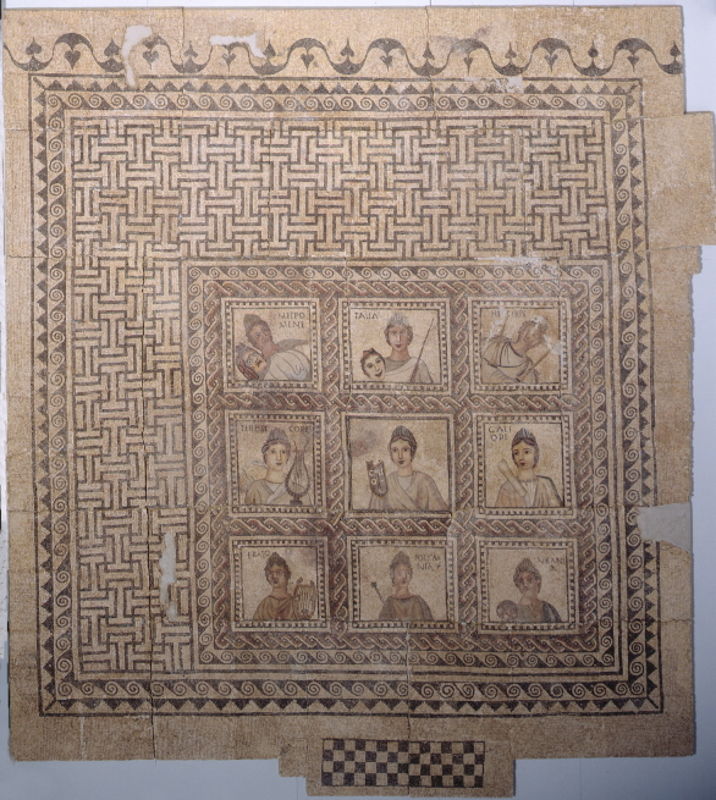
To explain the mosaic technique, we will look at the polychrome specimen found in Moncada (August 19th, 1920), which must have belonged to the cubiculum or rectangular bedroom of a Roman villa from the imperial era (first half of the 3rd century, Opus tessellatum, tesserae from marble and glass paste, with dimensions 698.5 x 611 cm) dedicated to the Nine Muses, daughters of Mnemosyne and Zeus, conceived during nine consecutive nights. Each one is represented as a bust, with the name and their characteristic attribute below. The ensemble is completed with a squared surface, decorated with geometric elements and framed with a band composed of saw teeth and posts.
The author's Fragment 1 (PMG 655), where she mentions one of the Nine Muses, is photocopied for group reading.
Once the mosaic technique has been explained and the aforementioned one has been given as an example, the teacher hands out the photocopy of Fragment 1 (PMG 655) by Corinna, in which the Muse Terpsichora is mentioned.
Based on the preserved fragment and the mosaic shown, 9 groups are formed with the students. Each group will start by cutting the plasticine into tesserae and grouping it by colours. On the wooden tablet they will draw the sketch of the assigned Muse to fill it with the glued tesserae. Once the mosaic is finished, they will have to give it a coat of varnish and join all the tablets to emulate the Moncada mosaic.
Necessary materials:
- Photocopied image of the allotted Muse.
- Coloured plasticine.
- Wooden boards (size DIN A3 or DIN A4).
- Knife for plasticine.
- Glue.
- Brush.
- Varnish for plasticine.
This activity has been assigned to 2nd of ESO, but it can also be done in other courses.
Description
The mosaic technique in Rome is explained, as well as the types of opus and the purpose of said decorative art, using the polychrome mosaic dedicated to the Nine Muses, which was found in Moncada.