Corinna and the Tanagras
Personajes:
Tema: The Tanagras: everyday art.
Competencias
Competencia en Comunicación Lingüística
Competencia Personal, social y de aprender a aprender
Competencia en conciencia y expresiones culturales
Materias y cursos por Sistema Educativo
España > Cultura Clásica > 3º ESO > Continuidad del patrimonio cultural. Literatura, arte y ciencia
Enunciado

Corina of Tanagra was a well-known Greek poet. Her simple style, her great erudition in mythology and her taste for local themes won her the admiration of many of her contemporaries. It is even said that she advised and won a poetic competition with Pindar, one of the most famous poets of ancient Greece.
Unfortunately, most of his work has not survived to the present day and no complete poem has survived.
One of the fragments speaks of the women of his city, Tanagra:
Fragment I (PMG 655)
«Terpsichore calls upon me
to sing good tales
for the white-robed women of Tanagra,
and the city delights greatly
in my clear, beguiling voice.
for whatever ... great ...
false ...»
KlincK, Anne L. (2008), "Corinna", in Woman's Songs in Ancient Greece, Montreal, Quebec: McGill-Queen's University Press, (retrieved on 28/05/2023) <https://www.jstor.org/stable/j.ctt8137f.11>
Thousands of clay statuettes depicting mainly women, children and scenes from everyday life were found during archaeological excavations of an ancient necropolis. They date from the 4th-3rd centuries BC, a century after the poet Corina, but their appearance and customs have probably not changed much. Because of the large number, this type of terracotta statuette has subsequently been called Tanagras and has been found at other Greek sites even though they do not come from the city of Corina.
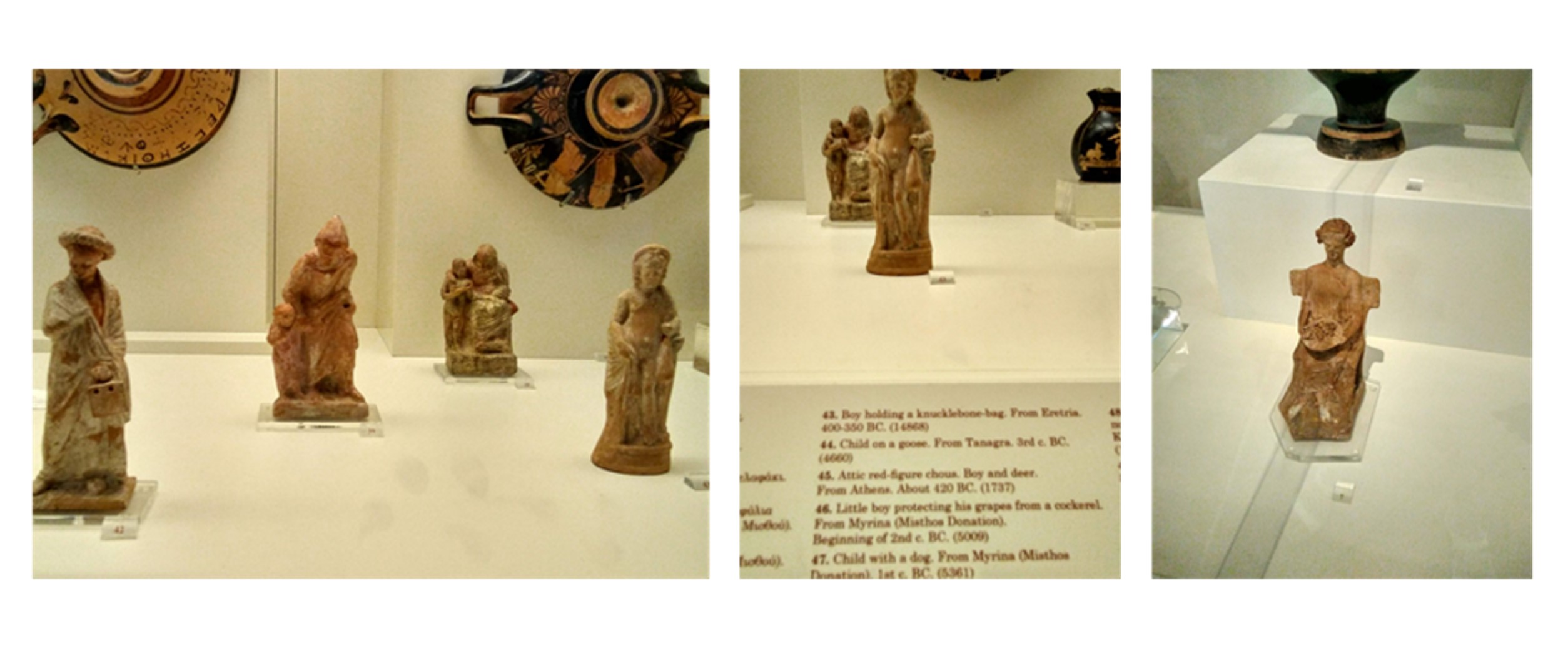
Own images, Thebes Museum, Greece. Neus Calvo
https://es.wikipedia.org/wiki/Estatuilla_de_Tanagra
QUESTIONS:
1.-Some of the best-known statuettes - such as the Lady in Blue or the Sophoclean - are inspired by great statues by masters such as Praxiteles, something which has led us to believe that they were smaller replicas, a kind of souvenir acquired for pure aesthetic delight and admiration of art for art's sake, a practice which would later be developed by the Roman patricians when ornamenting their residences.
Find a work by each of the following Greek sculptors: Praxiteles, Myron and Phidias. Discussion: Can Tanagras also be considered works of art or craftsmanship?
2.-Nowadays, statuettes with similar characteristics are also made for home decoration. Look for figures that remind you of an image of the Tanagras on the internet. You may find this link useful: https://www.lladro.com/es_es/clasico
3.-In 1870, when it was discovered, the Tanagra site suffered a serious despoilment, more than 8,000 tombs were looted during the night in search of the precious statuettes. This has also happened in other archaeological sites in our country. Find out if archaeological artefacts have been plundered in your locality and reflect on why this harms society. Spain has Law 16/1985 of 25 June 1985 on Spanish Historical Heritage:
«Spanish Historical Heritage is the main witness to the historical contribution of Spaniards to universal civilisation and to their contemporary creative capacity. The protection and enrichment of the assets that comprise it constitute fundamental obligations that bind all public authorities, according to the mandate addressed to them by Article 46 of the Constitution. »
And in its Title II, art. 15.5, it states:
«Archaeological Zone is the place or natural site where there are movable or immovable assets that can be studied with archaeological methodology, whether or not they have been extracted and whether they are on the surface, in the subsoil or under Spanish territorial waters. »
Observaciones y contexto
Corinna is part of the extensive but poorly known group of Greek poetesses. She is said to have been a disciple of the poetess Myrtis and to have rivaled Pindar himself. Although the local nature of her work prevented it from being widely disseminated at first, interest in Corinna and her poetry resurfaced at the end of Hellenism. The Greek poet Antipater of Thessalonica (1st century BC) included her in one of his epigrams as one of the nine muses of ancient lyric poetry, among which were, in his opinion, those of the highest quality.
This activity has been assigned to 3rd of ESO, but it can also be done in other courses. The related Key Competencies are LC, LL and CAE.
Descripción
Reading of a poem by Corina; study of the Tanagras and, through them, of the Greek sculpture of Praxiteles, Phidias and Myron; extrapolation of the Tanagras to the present day, investigating where this style of statuettes is still made; assessment and protection of the archaeological heritage, based on the plundering of the Tanagra site.