Mythical mountains
Characters:
Theme: Mountains of Greece that appear in important stories of mythology
Competencies
Competence in Linguistic Communication
Personal, social and learning to learn competence
Competence in cultural awareness and expressions
Subjects and year by Educational System
Spain > Classical culture > 4th ESO > Classical roots of today's world. Geographical framework of Greece and Rome
Enunciation

Corinna of Tanagra was a well-known Greek poetess. Her simple style, her great erudition in matters of mythology and her taste for local subjects helped her earn the admiration of many of her contemporaries. It is even said that, in a poetic competition, she advised and won Pindar, one of the most famous poets of ancient Greece.
Unfortunately, most of her work has not survived to this day and we do not have any complete poems. One of the longest fragments was found on a papyrus and it tells us about the poetry competition between two characters, Helicon and Cithaeron, whose names correspond to two well-known mountains of Boeotia.
1. Read the text and answer the questions:
(PMG 654) (a) Col. I
… The Curetes
reared the goddess’s divine
offspring in a cave, kept secret from
crooked-counselled Cronus,
when blessed Rhea stole him,
and from the immortals
he received great honour.” These things he sang.
And straightaway the Muses
were bidding the blessed gods to bring their secret voting pebbles
to gold-shining urns.
And they all stood up together.
And Cithaeron received the majority,
and quickly Hermes proclaimed him,
calling out that he had received
lovely victory, and with garlands
... the blessed gods were adorning him,
and his heart rejoiced.
But the other, Helicon, overcome
with sore resentment ...
[took] a smooth rock;
and the mountain ... pitiably ...
he hurled it from on high
into a myriad pieces.
KlincK, Anne L. (2008), "Corinna", in Woman's Songs in Ancient Greece, Montreal, Quebec: McGill-Queen's University Press, (retrieved on 28/05/2023) <https://www.jstor.org/stable/j.ctt8137f.11>
- What do you think the poem of one of the contenders, with which the fragment begins, was about?
- Who runs the contest? Who acts as a judge?
- Who wins the contest?
- How does the loser react?
2. Do your research. As we have already said, the names of Cithaeron and Helicon correspond to two well-known mountains in Greece, which are related to mythology. The Helicon was the home of the Nine Muses and, there, they had their cave and a consecrated spring. For its part, Cithaeron appears in several mythological stories as, for example, the mountain on which the hero Oedipus was abandoned.
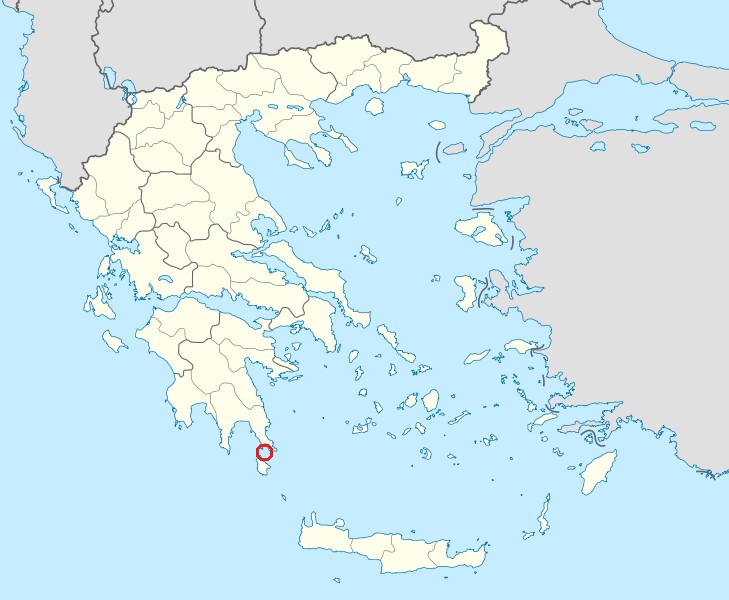
Search the internet for the suggested Greek mountains and complete the table following the example. All of them are related or are the scene of some known myth. Find out where they are located and mark it on the map approximately.
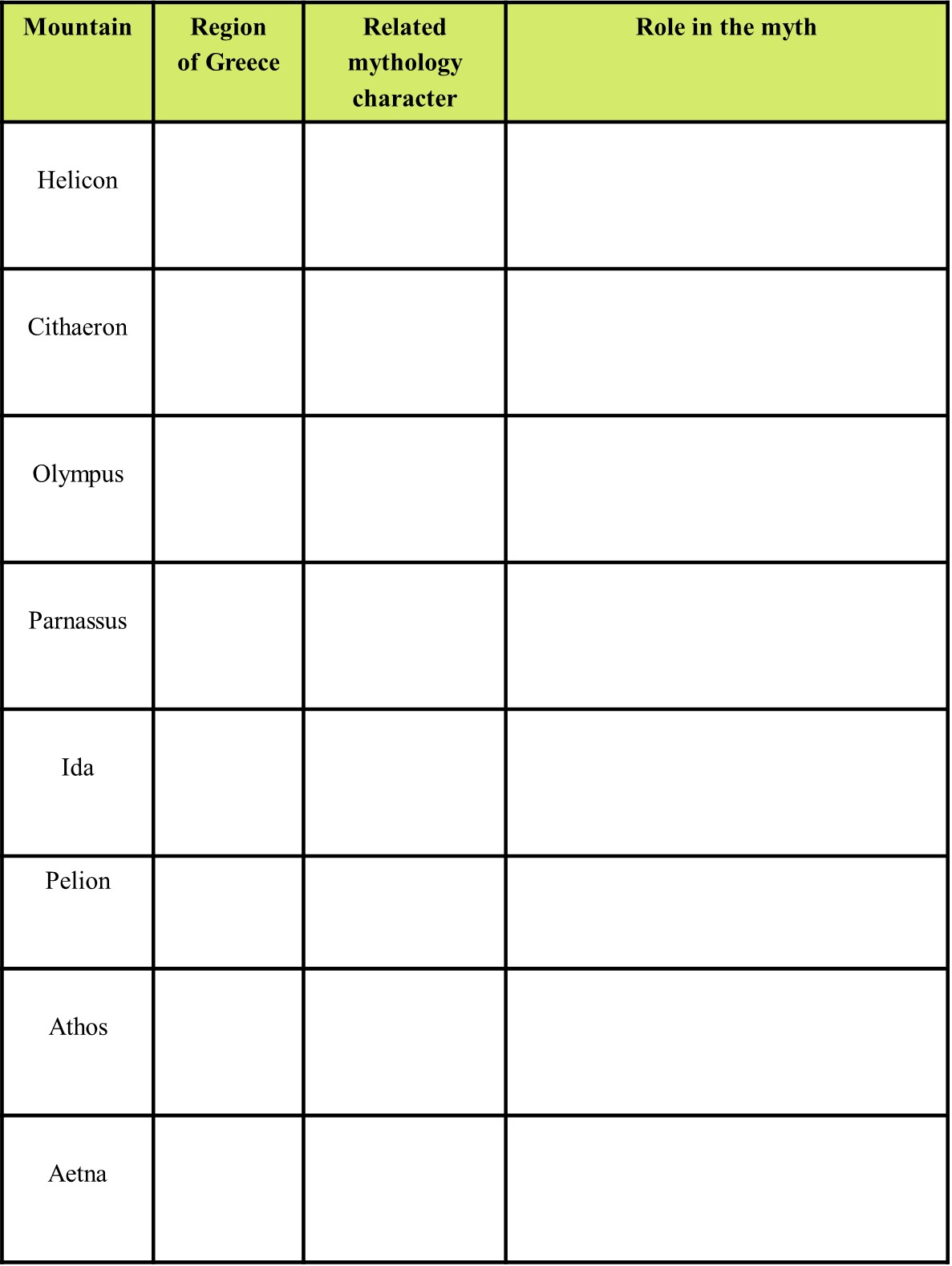
Locate them on the map. Only in one case you will not be able to do it. In which case?
Observations and context
Corinna is part of the extensive but poorly known group of Greek poetesses. She is said to have been a disciple of the poetess Myrtis and to have rivaled Pindar himself. Although the local nature of her work prevented it from being widely disseminated at first, interest in Corinna and her poetry resurfaced at the end of Hellenism. The Greek poet Antipater of Thessalonica (1st century BC) included her in one of his epigrams as one of the nine muses of ancient lyric poetry, among which were, in his opinion, those of the highest quality.
As a result of the mention of mounts Helicon and Cithaeron in Corinna's poems, a list of oronyms related to known myths is proposed to the students. The students will have to locate them on a map of Greece, find out what myth takes place in it and briefly explain it. The result of their investigations can be reflected in a joint mural.
This activity has been assigned to 4th of ESO, but it can also be done in other courses, reducing the number of terms to investigate if necessary.
Description
Reading of fragments, data collection, information search and geographic location.