Agnesi Curve representations
Personajes:
Tema: Elementary functions
Competencias
Competencia Matemática, en ciencia, tecnología e ingeniería
Competencia Personal, social y de aprender a aprender
Competencia en conciencia y expresiones culturales
Materias y cursos por Sistema Educativo
España > Matemáticas > 4º(B) ESO > Sentido algebraico
España > Matemáticas > 4º(B) ESO > Sentido socioafectivo
Enunciado

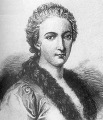
Maria Gaetana Agnesi was a famous 18th-century mathematician who published the first complete book on differential and integral calculus. In that book, she explained a famous function that would later receive the name of "the witch of Agnesi".
1. Here we have three Agnesi's curves. What characteristics do they have in common? Describe them.
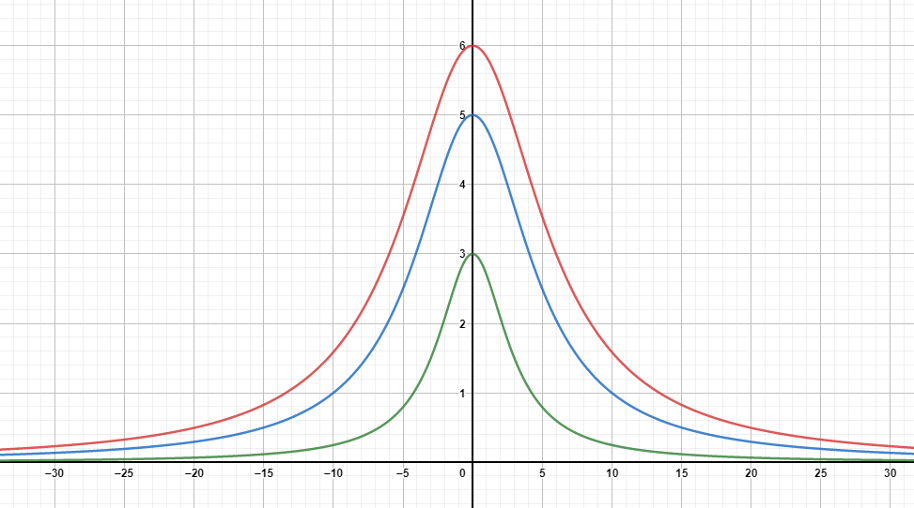
2. The functions represented have the following formulas (from top to bottom) (g is red, f is blue, and h is green).
$$\begin{array}{l} \displaystyle g : y = \frac{216}{x^2+36}\\[1em] \displaystyle f : y = \frac{125}{x^2+25}\\[1em] \displaystyle h : y = \frac{27}{x^2+9} \end{array}$$
Can you find the general algebraic expression for the Agnesi's curve?
Tip: Pay attention to the pairs of numbers that appear in each function: 216 and 36, 125 and 5 and 9 and 27. What do they have in common?
3. Here we have represented three Agnesi's curves. Calculate the algebraic expression of the function for a = 4 and represent it with the others.
Observaciones y contexto
- It is suggested to work on questions 1 and 2 with the whole group, instead of individually.
- Alternatively, we can tell students how this curve was mistranslated as "the witch of Agnesi" instead of "Agnesi’s curve" and explore what connotations or motivations there could be behind that mistranslation (by a man) of one of the best texts on mathematics at the time, written by a woman.
- Some of Maria Gaetana Agnesi's forerunners in mathematics, philosophy and astronomy are Theano of Crotone (c. 546 BC - c. 450 BC), Hypatia of Alexandria (c. 370 – c. 416) and, in the early modern period, Sophia Brahe (1556-1643), Maria Cunitz (1610-1664), and Elena Lucrezia Cornaro Piscopia (1646 -1684).
- Some of her contemporaries were renowned scientists such as Margaretha Kirch (1703-1744), astronomer; Faustina Pignatelli Carafa (1705-1785), physicist and mathematician; Émilie du Châtelet (1706-1749), mathematician, physicist and philosopher; Laura Maria Catharina Bassi (1711-1778), scientist, poet, and philosopher; Angelique-Marguerite le Boursier du Coudray (1712-1794), midwife; Dorothea Christiane Leporin (1715-1762), doctor; Anna Morandi Manzolini (1716-1774), anatomist; Marie-Geneviève-Charlotte Thiroux d’Arconville (1720-1805), chemist, anatomist, and biologist; María Juana Rosa Andresa Casamayor de la Coma (1720-1780), mathematician; Nicole-Reine de la Brière Lepaute (1723-1788), astronomer; Marie Anne Victoire Pigeon (1724-1767), mathematician, or Maria Angela Ardinghelli (1728-1825), mathematician and physicist, among others.
- Other relevant scientists in the 18th century were Maria Christina Bruhn (1732-1808), chemist and inventor; Claudine Picardet (1735-1820), chemist, mineralogist and meteorologist; Jeanne Baret (1740-1807), botanist and explorer; Caroline Lucrecia Herschel (1750-1848), astronomer; Marie-Anne Pierrette Paulze (1758-1836), chemist; and Sophie Germain (1776-1831), mathematician and physicist.
Descripción
In this activity, there are three graphs representing different witches of Agnesi. The idea is that students learn the common aspects of these graphs so that they can come to a generalisation of its equation from particular cases and, in the end, that students draw a representation of the witch.