The myth of Memnon in Greek pottery
Characters:
Theme: Greek pottery
Competencies
Competence in Linguistic Communication
Personal, social and learning to learn competence
Competence in cultural awareness and expressions
Subjects and year by Educational System
Spain > Classical culture > 1st ESO > Continuity of cultural heritage. Literature, art and science
Enunciation

It is based on a fragment of the poet Julia Balbilla, who lived in the 2nd century AD. We will look at the mythological figure of Memnon, depicted on Greek pottery and review the main styles, types and uses of the vases.
1.- Read Julia Balbilla's poem; a poetess from the 2nd century AD related to the myth of Memnon and answer the questions.
At Thebes there were two Colossi of Amenhotep III, which the Greek and the Roman associated with Memnon. One of them made sounds at dawn, produced by the heating of the stone after it had been cracked by an earthquake, which they identified with Memnon's call to his mother. It was a place of visit for the important people of that time who engraved their experience in the sculpture itself. Such is the case of Julia Balbilla, who joined the empress Vibia Sabina and the emperor:
“I, Balbilla, heard from the stone when it spoke. Either the divine voice of Memnon or Phamenoth. I came here alongside my beautiful queen Sabina as the sun kept its course in the first hour”. (Translation by Rosenmeyer 2008 and Brennan 1998).
a.- Why is it called the speaking stone?
b.-What time of the day does this phenomenon happen?
c.-What is its natural explanation?
2.-Take a look at the two pictures of the myth of Memnon in pottery and answer the questions:
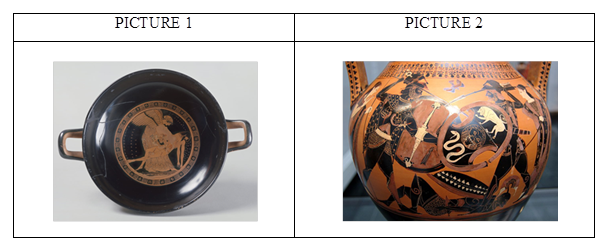
Picture 1


a.-Which of the following episodes of life appears in each picture?
· Memnon is an Aethiopian king, son of Tithonus and Eos, goddess of dawn.
· He helps his uncle Priam during the Trojan War.
· He kills Antilochus, a friend of Achilles and Patroclus.
· Achilles fights against Memnon, before Tethys and Eos, with Antilochus laying on the floor.
· Eos picks up Memnon's corpse.
Picture 1:
Picture 2:
b.-What colour predominates in the figures and in the background (red/black) of each vase?
Picture 1:
Picture 2:
3.- Check the typology of the vases and answer:
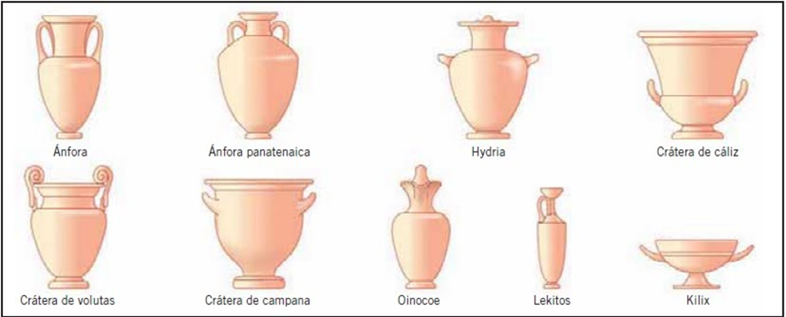
a.- Which small vessel is image 1?
b.-What sort of krater is image 2?
4.-Read the following excerpt and identify the style and the period the pieces on Memnon.
Between the 9th and 6th century BC, four ceramic techniques or styles followed one another over time:
The geometric style defines pottery from the 9th-8th centuries BC. Geometric decoration has great importance. The motifs are black on the natural background of the vessel and are arranged in bands.
The orientalizing style corresponds essentially to the 7th century BC and its main centre was Corinth. The oriental influence can be seen in the repetitive rhythm of the often-fabulous animals and their arrangement in bands.
The black figure technique was developed during the Archaic period, in the 6th century BC. The motifs were painted in black on the red background of the vase, and the details of the black figures, which were left in white, were marked with punch incisions. The bands disappear and there is a clear preference for the human figure and mythological themes.
The red figure technique has been used approximately since 530 BC and was maintained during the classical period. The procedure was contrary to the former: it was painted in black on the background of the scenes, and the silhouettes of the figures were left in the red colour of the vase, on which the details were painted with a brush. This allowed a better precision with the punch.
Picture 1:
Picture 2:
5. All that remains to be known is the primary use of each ceramic vessel:
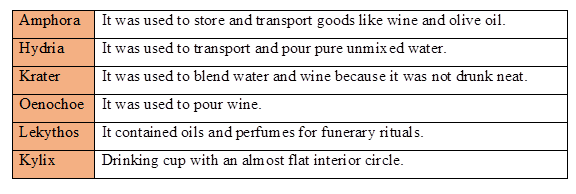
Picture 1:
Picture 2:
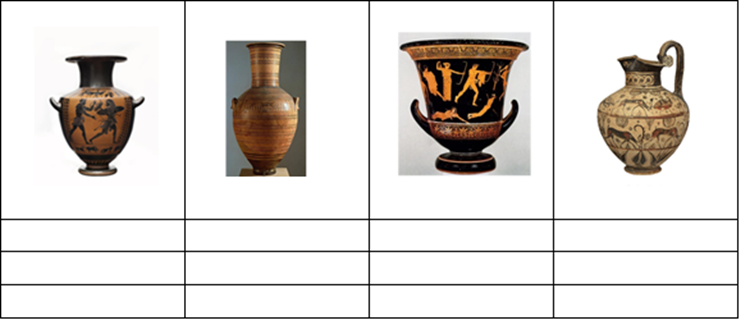
6.-Identify the following characteristics with each vase:
- Type of vase (oenochoe, amphora, hydria, crater).
- Pottery style
- Use
Observations and context
Julia Balbilla, Damo and Caecilia Trebula had their short compositions engraved in Greek on the left leg of one of the Colossi of Memnon. These travelling poets of Roman times, along with others of very different styles, such as Sulpicia the elegiac, Sulpicia the satirical, Herennia Procula, Claudia Trofime and Teosebia are heirs to the poetic tradition of Sappho that began in the 7th century BC and finished in the 4th century with Aconia Fabia Paulina.
When her brother, Gaius Julius Antiochus Epiphanes Philopappos, one of the first men of Oriental descent to become consul in Rome, died, Julia Balbilla built for him a funerary monument, the Philopappos, on the hill of the Muses, southwest of the Acropolis of Athens. Julia Balbilla built for him a funerary monument, the Philopappos, on the hill of the Muses, in the southwest of the Acropolis of Athens.
Description
Reading of a poem by Julia Balbilla on the myth of Memnon and its identification in ceramics.