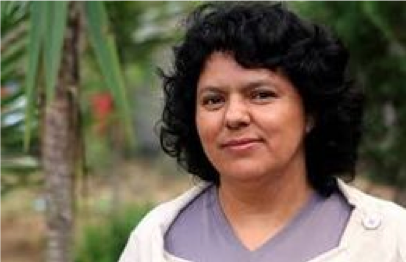
Review
Feminist activist and indigenous and social leader from Honduras. She founded the Civic Council of Popular and Indigenous Organizations of Honduras (COPINH), from which she led the defence of the environment by opposing to the construction of hydroelectric and mining projects that threatened the natural resources and traditions of the Lenca people. In 2015, she was awarded the Goldman Environmental Prize, the world's highest award for environmental activists. She was persecuted, imprisoned and finally assassinated in 2016 for fighting against the violations to which indigenous communities in Honduras are subjected.
Activities
Justifications
- Feminist activist, indigenous and social Honduran leader (Lenca people).
- Founder of the Civic Council of Popular and Indigenous Organizations of Honduras (COPINH).
- She opposed the mining licenses and the usage of rivers for building hydroelectric plants that would expropriate ancestral land and destroy the natural resources of indigenous communities.
- She condemned the intervention of the United States in her country (she rejected the creation of military bases in Lenca territory).
- She was a candidate for vice-president in the national elections before the "coup d'état" in 2009, which she protested against.
- She received the Goldman Environmental Prize in 2015 and the posthumous award Champions of the Earth (UN).
Biography
Berta Isabel Cáceres Flores [...] was a Lenca indigenous leader, feminist, and environmental activist from Honduras.
[...] During her childhood and teenage years, Berta Cáceres witnessed and joined her people's struggles. One of her siblings was shot and persecuted, and another one was kidnapped and tortured for six months. Her mother was guarded for twelve years and kidnapped in 1992 by a School of the Americas' colonel, who was later promoted [...]
She married the indigenous leader Salvador Zúñiga, and they had four children.
In March, 1993, she co-founded the Civic Council of Popular and Indigenous Organizations of Honduras (COPINH) which "fights in defence of the environment, the rescue of the Lenca culture and to improve the living conditions of the population of the region".
Her environmental activism stood out; she was particularly active in the fight against the privatisation of rivers and against hydroelectric dam projects of international investors, especially against the Agua Zarca dam hydro project on the Gualcarque river in the department of Santa Bárbara. She also fought against mining and timber projects to protect the environment.
In 2009, she led protests against the Honduran coup d'état to the then president of Honduras, Manuel Zelaya, on June 28. Besides, she criticised the government of Juan Orlando Hernández.
[…]
In 2013, Cáceres and other indigenous leaders were accused of inducing people to commit crimes of usurpation, coercion and continued harm to DESA, and for that reason she was held in pre-trial detention. Amnesty International declared that the charges had to be dropped and that if activists were imprisoned, they would be considered prisoners of conscience.
She also condemned the intervention of the United States in Honduras, the fact that they used the country as a laboratory, the training of militiamen that were soldiers by day and mercenaries by night, and the construction of the United States' biggest naval station in Latin America in the Catarasca Lagoon, which has underground passages that -allegedly- are not used to fight drug trafficking. She reported bribes of 1 to 20 million lempiras to mayors and indigenous leaders.
She was assassinated after years of threats against her life. Her murder was widely condemned in America and part of Europe.
In July 2021, David Castillo, manager of DESA, was found guilty as the intellectual author of her murder.
Wikipedia, retrieved on 19/03/2022, <https://es.wikipedia.org/wiki/Berta_Cáceres>
Bibliography
Casasús, Mario (2016). “#8M Entrevista con Berta Cáceres In Memoriam” in desInformémonos, retrieved on 19/03/2022, <https://desinformemonos.org/entrevista-con-berta-caceres-in-memoriam/>
COPINH, retrieved on 06/04/2022, <https://copinh.org/>
Emanuelsson, Dick y Emanuelsson, Mirian (2013). “Entrevista a Berta Cáceres, coordinadora de Consejo Popular e Indígena de Honduras COPINH”, Río Blanco, Departamento de Intibuca, Honduras, C. A (2013). YouTube, retrieved on 19/03/2022, <https://www.youtube.com/watch?v=Yiu_G9gdQ4g>
Front line defenders, retrieved on 19/03/2022, <https://www.frontlinedefenders.org/es/profile/berta-caceres>
Korol, Claudia (2018). Las revoluciones de Berta. Ediciones América Libre.
Lakhani, Nina (2021). “Conversación virtual en torno a la presentación del libro ¿Quién mató a Berta Cáceres?” in Fundación espacio Público, retrieved on 19/03/2022, <https://espacio-publico.com/quien-mato-a-berta-caceres-de-nina-lakhani>
McDonald, Allan. Berta, un crimen que corre por los ríos de la conciencia, retrieved on 06/04/2022, <https://copinh.org/un-comic-de-allan-mcdonald-sobre-la-lucha-de-berta-caceres>
Berta Cáceres' official website, retrieved on 19/03/2022, <https://www.facebook.com/justiceforberta/>
TV3. “Les llavors de Berta Cáceres” (2019), documentary by Col·lectiu de Periodistes Contrast i Entrepobles with the support of Lafede.cat. available in TV3 a la carta, retrieved on 19/03/2020, <https://www.ccma.cat/tv3/alacarta/latituds/les-llavors-de-berta-caceres/video/5912827/>
“Última entrevista a Berta Cáceres, dirigente popular y activista feminista hondureña: “Nuestra vida pende de un hilo” in Nodal Noticias de América Latina y del Caribe, retrieved on 19/03/2022, <https://www.nodal.am/2016/03/ultima-entrevista-a-berta-caceres-dirigente-popular-y-activista-feminista-hondurena-nuestra-vida-pende-de-un-hilo/>
Didactic approach
In 1st and 3rd of ESO, she can be linked both to the physical environment and human space, regulating the level of complexity and depth, especially when dealing with the water cycle, with a focus on the protection of the hydrosphere, and the Earth's landscapes, which are threatened not only environmentally but also in relation to human rights.
With regard to the content of history in 4th of ESO, the social defence of indigenous communities can be linked to anti-colonial resistance and abolitionism.
Documents