Reseña
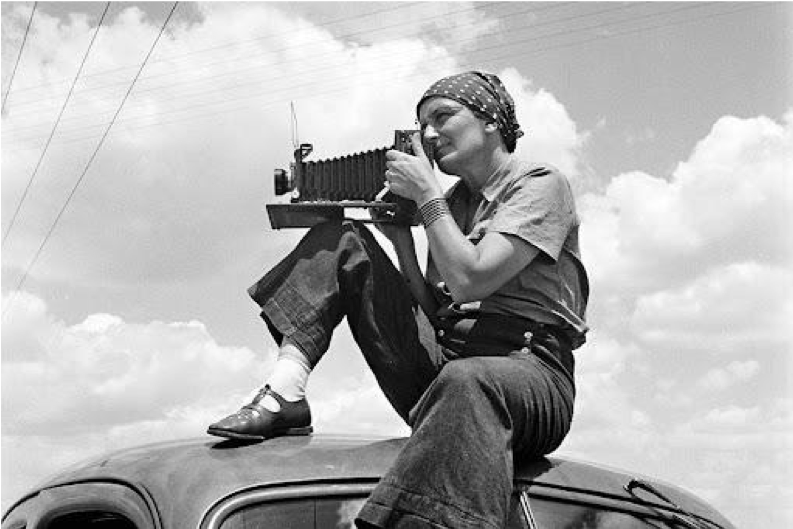
American photojournalist whose reports from the 1930s in the United States became iconic images that went around the world and have reached our days as one of the best testimonies of the economic and social crisis that hit the country during the Great Depression.
The most outstanding aspect of these photographs is their humanity, as shown in his most famous image known as Migrant Mother (1936).
Justificaciones
- American photographer with a long professional career.
- Her work is relevant for a deep understanding of the most dramatic moments in the history of the United States, and therefore of the West in the twentieth century.
- She reported on the 1930s in the United States in the context of the economic and social crisis that hit the country during the Great Depression.
- In his work, the images of migration to the West Coast stand out.
- Pioneer of photojournalism.
Biografía
Dorothea Lange had a difficult and lonely childhood due to physical ailments caused by polio. She took her first photographs while walking on New York's Lower East Side. She learned photography in a portrait studio and trained at the Clarence H. White School of Photography.
In 1918 she moved to San Francisco where she lived for the rest of her life.
In 1920 she married the painter Maynard Dixon. Until now her images were inspired mainly by landscapes, but after the crash of 1929 and the subsequent Great Depression of the 1930s, it became clear to her that she had to focus on people. At the age of 40 she was part of the project that would bring her worldwide recognition, she was hired by the Department of History of the U.S. Resettlement Administration.
The administration provided emergency relief to destitute rural families and, in 1937, was renamed the Farm Security Administration to reflect its new purpose. The government agency launched an extensive project that would run through 1942 with the intention of "introducing America to Americans" through photography. The project received enough funding to allow it to hire some of the best photojournalists of the time to travel the country and capture the American reality.
In 1935 she divorced Dixon and married economist Paul Schuster Taylor, and together they made a documentary film about rural poverty and the exploitation of growers and migrant workers over the next six years.
Dorothea Lange was able to document the widespread crisis in a truly creative way, to the point that one of the images, Migrant Mother (1936) captured the public's attention and became representative of poverty and hardship.
The photographer became aware of the plight of the underprivileged and her photographs of Texas and Alabama farm workers taken from a low angle, or even from the ground, sought to contextualize the people portrayed in their surroundings.
In 1941, after the bombing of Pearl Harbor, Lange photographed the forcible evacuation of Japanese Americans from concentration camps in western Japan, showing the policies of detaining people without criminal charges and without the right to defend themselves. Her images were so critical that the Army seized them.
In the 1950s, this "people's photographer" accepted a teaching position at the San Francisco School of Photography and in 1952 participated in the creation of Aperture magazine. Her images were exhibited shortly after her death in 1972 at the Museum of Modern Art and the Whitney Museum of American Art in New York.
Wikipedia, 03/07/2023,
https://es.wikipedia.org/wiki/Dorothea_Lange
Biografía y vidas, 03/07/23,
https://www.biografiasyvidas.com/biografia/l/lange_dorothea.htm
Obras
- Migrant Mother, Nipomo, 1936. Photograph. The Oakland Museum of California.
- Cars on the Road, 1936. Photograph. Library of Congress, United States.
- Ex-Slave with a long memory, Alabama, 1938. Photograph. The Oakland Museum of California.
- Manzanar Relocation Center, Mazanar, California, 1942. Photograph. The Oakland Museum of California.
Bibliografía
- Moma, 03/07/2023, <https://www.moma.org/artists/3373>
- Oakland Museum of California, accessed on 16/03/2022, <https://dorothealange.museumca.org>
- Oakland Museum of California, accessed on 16/03/2022,
<https://dorothealange.museumca.org/image/untitled-on-nob-hill-san-francisco/A67.137.93001/?section=the-new-california>
- Crespo Maclennan, Gloria. “Dorothea Lange: una activista visual”, Babelia, El País, 27/10/2018, accessed on 03/07/2023,
https://elpais.com/elpais/2018/09/27/album/1538052709_305875.html#foto_gal_1
- Brunet, François. “Dictionnaire universal des créatrices”, Archives of Women Artists,
Resarch and Exhibitions, accessed on 03/07/2023, https://awarewomenartists.com/en/artiste/dorothea-lange/
- Fernández, Tomás; Tamaro, Elena. “Biografia de Dorothea Lange”, Biografías y Vidas. La enciclopedia biográfica en línea, 2004, accessed on 03/07/2023, https://www.biografiasyvidas.com/biografia/l/lange_dorothea.htm
Enfoque Didáctico
She can be tackled in history in 4th of ESO and in history of the contemporary world in 1st of Bachillerato. Her work can be used in particular as a primary source to explain the social reality of the United States in the 1930s crisis, using pictures like Migrant Mother, which is considered an iconic picture of the time. Her photographs of concentration camps for Japanese-American citizens in California also refer to the tense climate and the racism that prevailed in the United States during World War II.
Her works can be analysed from an artistic point of view in the subject of audiovisual culture in 1st and 2nd of Bachillerato, both in the denotative and connotative levels.
Documentos