How these flies bite!
Personatges:
Tema: Ecosystems
Competències
Competència en Comunicació Lingüística
Competència Matemàtica, en ciència, tecnologia i enginyeria
Competència personal, social i aprendre a aprendre
Competència Ciutadana
Matèries i cursos per Sistema Educatiu
Espanya > Biologia i Geologia > 1r ESO > Ecologia i sostenibilitat
Espanya > Biologia i Geologia > 3r ESO > Ecologia i sostenibilitat
Enunciat

This drawing is one of Eleanor Omerod's drawings of the Hypoderma bovis fly, which causes bovine hypodermosis or "zits". The drawing was distributed in pamphlets for cattlemen, with advice on how to identify the flies that cause "barros" and how to combat them.
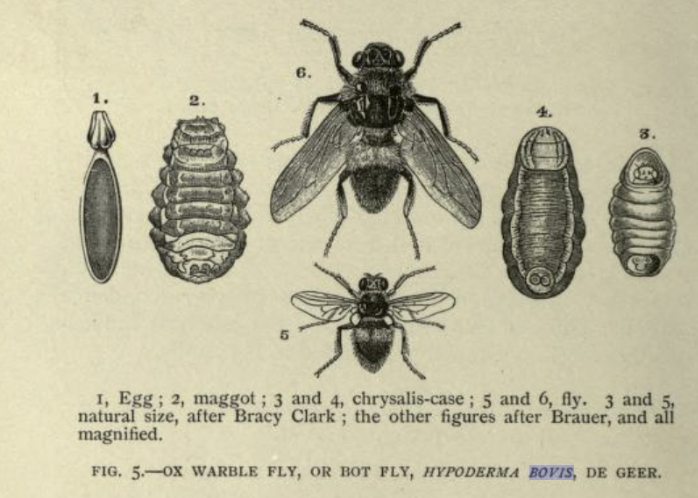
This fly has a life cycle in which during the summer it lays its eggs in the body of cows. During the fall and winter, the larvae move under the skin of the animal, either by being swallowed by the cows or by piercing the skin to get under it. There, the larvae mature (generating lumps called muds, which are usually observed in February to March) and leave the animal's body through the piercing hole.
The effects of bovine hypodermosis are very negative for the cow, as they result in lower milk production, a higher incidence of mastitis, weight loss and depreciation of the hides.
Within the ecosystem, the relationship between the Hypoderma bovis fly and cows is an interspecific relationship:
1. Why?
2. What type of relationship is involved? Justify your answer.
3. What other types of interspecific relationships do you know of? Describe them and give an example of each one.
4. Find an example of an arthropod that is parasitic on humans.
Observacions i context
Eleanor Ormerod was a contemporary of scientists such as Maire Curie, Nettie Stevens and Ellen Swallow Richards, among others. Like the naturalist Maria Sibylla Merian (1647-1717) Eleanor illustrated her observations with her own drawings, which reflected in detail many aspects of the life cycles of the insects she studied.
Throughout history, the field of Biology and Natural Sciences has been plagued by women researchers, such as Hildegard of Bingen (1098-1179) who was one of the most versatile and influential women of the Middle Ages in 12th century Western Europe, the anatomy professor Anna Morandi Manzolini (1716-1774), Laura Bassi (1711-1778) who fostered the constitution of a network of experimenters that connected Italy with the scientific culture of France and England.
More recently, in the 20th and 21st centuries women such as Jane Morris Goodall, known for her 55-year study of the social and family interactions of wild chimpanzees in Gombe Stream National Park in Tanzania, Rita Colwell, a researcher in oceanography and bacteriology. Tu Youyou Chinese scientist, known for discovering artemisinin (also known as dihydroartemisinin), used to treat malaria who in 2015 won the Nobel Prize in physiology and medicine. Finally, Josefina Castellví, oceanographer, the first Spaniard to participate in an international expedition to Antarctica in 1984.
Descripció
-Short answer activity.
-Objective: to work on interspecific relationships between living beings in an ecosystem.