Electric current intensity
Personatges:
Tema: Electrical energy
Competències
Competència Matemàtica, en ciència, tecnologia i enginyeria
Matèries i cursos per Sistema Educatiu
Espanya > Física i Química > 3r ESO > L'energia
Enunciat

In electricity, an arc is an electrical discharge that occurs between two electrodes that are subjected to a potential difference and are placed in a gaseous atmosphere. This produces light and heat. It was studied at the beginning of the 20th century by Hertha Marks Ayrton, an engineer, mathematician, physicist and inventor. It was used as a source of high-intensity artificial light, much brighter than incandescent bulbs, and was used in the film industry to achieve high luminous intensities in film shooting, as well as in film projectors. It is still in use today for its calorific effects in metal welding and the melting of refractory materials.
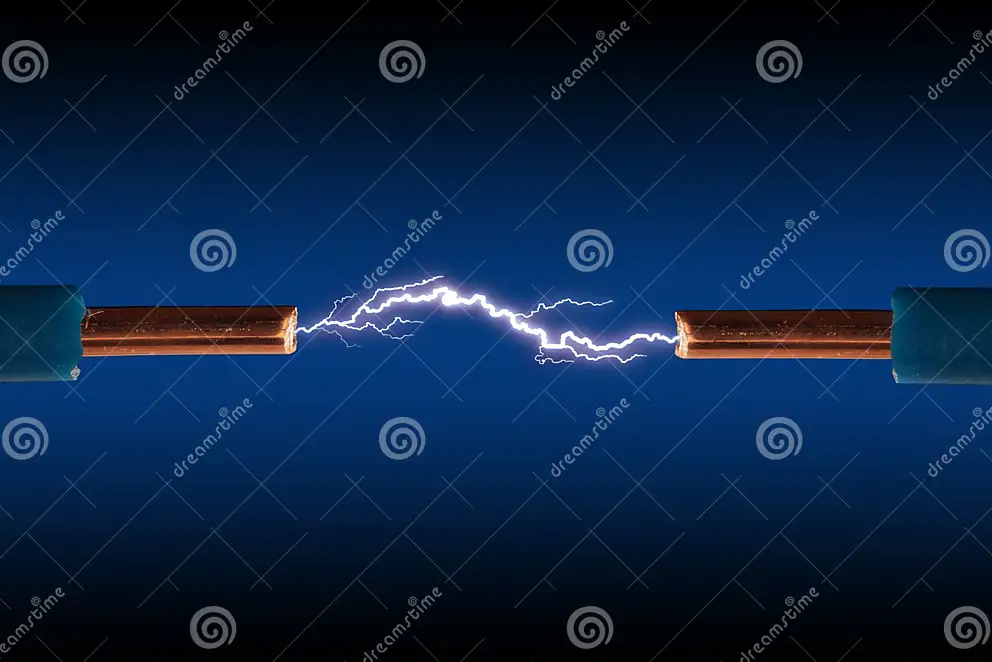

In order to initiate an arc, the end of two electrodes, usually two graphite pencils, have to meet. An intense current (10 amperes) goes through them. This current causes a great heating in the contact point when the electrodes separate.
- How long will it take for 0,5 C to pass?
- Calculate the number of electrons that will have circulated through the electrodes half an hour later (e=1,6.10-19 C)
Observacions i context
Together with Charlotte Scott (a British mathematician), the first wrangler (student to pass her third year of mathematics at Cambridge University with distinction) at Girton (Britain's first residential college for women's university education). She founded a mathematics club and was the first woman to join the New York Mathematical Society.
Marie Sklodowska-Curie (1867-1934), Nobel laureate in physics in 1903, knew Hertha Ayrton, who was invited by the Societé de Physique to present the article La formation des rides de sable et les mouvements internes de l'eau oscillant in Paris. Hertha Ayrton asked Marie Curie to sign the international petition to free the British suffragettes in 1912. Her inventions were partly financed by Lady Goldsmid and the feminist pedagogue Barbara Leigh-Smith Bodichon (1827-1891). She was a member of the Women's Social and Political Union or WSPU, founded by Emmeline Pankhurst (1858-1928).
Laura Bassi (1711-1778) and Maria Angela Ardinghelli (1728-1825) preceded her in studying electromagnetism and electrical phenomena. She was a contemporary of Beulah Louise Henry (1887-1973), known as 'Mrs Edison' for her more than 100 inventions and 49 patents, and Edith Clarke (1883-1959), an engineer specialising in the analysis of electrical systems. Later scientists and inventors in the field include Hedy Lamarr (1914-2000) and Esther M. Conwell (1922-2014).
Barbara Ayrton, Hertha's daughter, studied chemistry and physiology at London College and joined the WSPU in 1906. She was a leading feminist activist and a member of parliament for the Labour Party.
Descripció
Understanding the concept of electric current as a flow of charges in movement, electrons through a conductor, and interpreting the meaning of current intensity.