The pendulum clock seller
Personajes:
Tema: Linear functions. Function applications.
Competencias
Competencia en Comunicación Lingüística
Competencia Matemática, en ciencia, tecnología e ingeniería
Competencia Personal, social y de aprender a aprender
Competencia en conciencia y expresiones culturales
Materias y cursos por Sistema Educativo
España > Matemáticas > 3º ESO > Sentido algebraico
España > Matemáticas > 3º ESO > Sentido socioafectivo
Enunciado

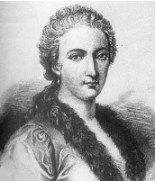
Portrait of Maria Gaetana Agnesi
Maria Gaetana Agnesi, an 18th-century Italian mathematician, famous for "the witch of Agnesi", decided to buy a new pendulum clock. Maria Gaetana Agnesi, an 18th century Italian mathematician, well known for the "Agnesi curve", is mainly known in the area of analysis, with the publication of the first complete book on Differential and Integral Calculus.
Let us suppose the situation in which Maria Gaetana Agnesi had to help a friend of hers who was a watch seller".
Read carefully and try to answer the questions:
The clock seller, a friend of Maria, told her about her finances: "Now, my monthly income is €50 for each clock I sell, but the company has suggested a new approach and given me the following conditions: €300 fixed euros a month and €20 commission for each clock I sell. Maria, as an extraordinary mathematician, can you help me decide what's best for me?".
Help both friends by answering the following questions:
a) Find the functions that connect the number of clocks sold with the monthly income in each situation.
d) What are the kind of functions obtained?
c) Draw their graphical representation on the same axes.
d) If you were the seller, would you accept the new conditions? Give reasons for your answer.
Observaciones y contexto
- Maria Gaetana Agnesi was a child prodigy that, from a very young age, was able to communicate in several languages and to have deep philosophical and scientific conversations. Her sister, Maria Teresa Agnesi, was a musician and composer.
- Some of Maria Gaetana Agnesi's forerunners in mathematics, philosophy and astronomy are Theano of Crotone (c. 546 BC - c. 450 BC), Hypatia of Alexandria (c. 370 – c. 416) and, in the early modern period, Sophia Brahe (1556-1643), Maria Cunitz (1610-1664), and Elena Lucrezia Cornaro Piscopia (1646 -1684).
- Some of her contemporaries were renowned scientists such as Margaretha Kirch (1703-1744), astronomer; Faustina Pignatelli Carafa (1705-1785), physicist and mathematician; Émilie du Châtelet (1706-1749), mathematician, physicist and philosopher; Laura Maria Catharina Bassi (1711-1778), scientist, poet, and philosopher; Angelique-Marguerite le Boursier du Coudray (1712-1794), midwife; Dorothea Christiane Leporin (1715-1762), doctor; Anna Morandi Manzolini (1716-1774), anatomist; Marie-Geneviève-Charlotte Thiroux d’Arconville (1720-1805), chemist, anatomist, and biologist; María Juana Rosa Andresa Casamayor de la Coma (1720-1780), mathematician; Nicole-Reine de la Brière Lepaute (1723-1788), astronomer; Marie Anne Victoire Pigeon (1724-1767), mathematician, or Maria Angela Ardinghelli (1728-1825), mathematician and physicist, among others.
- Other relevant scientists in the 18th century were Maria Christina Bruhn (1732-1808), chemist and inventor; Claudine Picardet (1735-1820), chemist, mineralogist and meteorologist; Jeanne Baret (1740-1807), botanist and explorer; Caroline Lucrecia Herschel (1750-1848), astronomer; Marie-Anne Pierrette Paulze (1758-1836), chemist; and Sophie Germain (1776-1831), mathematician and physicist.
Descripción
Obtaining the algebraic expressions of a direct proportionality function and a linear function from a statement. The goal is to obtain their graphical representations. Finding the point where the two functions meet. Deciding, using the graphs as a basis, what the most convenient decision is.