Experimenting with global warming in the kitchen
Personajes:
Tema: Relationships and functions
Competencias
Competencia en Comunicación Lingüística
Competencia Matemática, en ciencia, tecnología e ingeniería
Competencia Personal, social y de aprender a aprender
Competencia Ciudadana
Competencia en conciencia y expresiones culturales
Materias y cursos por Sistema Educativo
España > Matemáticas > 3º ESO > Sentido algebraico
España > Matemáticas > 3º ESO > Sentido socioafectivo
Enunciado

Eunice Foote, born in 1819 in the USA, did home experiments using the little knowledge of biology and chemistry that she acquired at school, and obtained excellent results.
1- In one of these experiments, she used two glass tubes with a thermometer inside. One of them had regular air inside, and the other one had humid air. Once the temperature of both tubes reached 75ºF, she left them outside to warm up in the sun and wrote down the temperature indicated in the thermometers. She collected the information in the following tables. Use them to draw both graphs in the same axis.
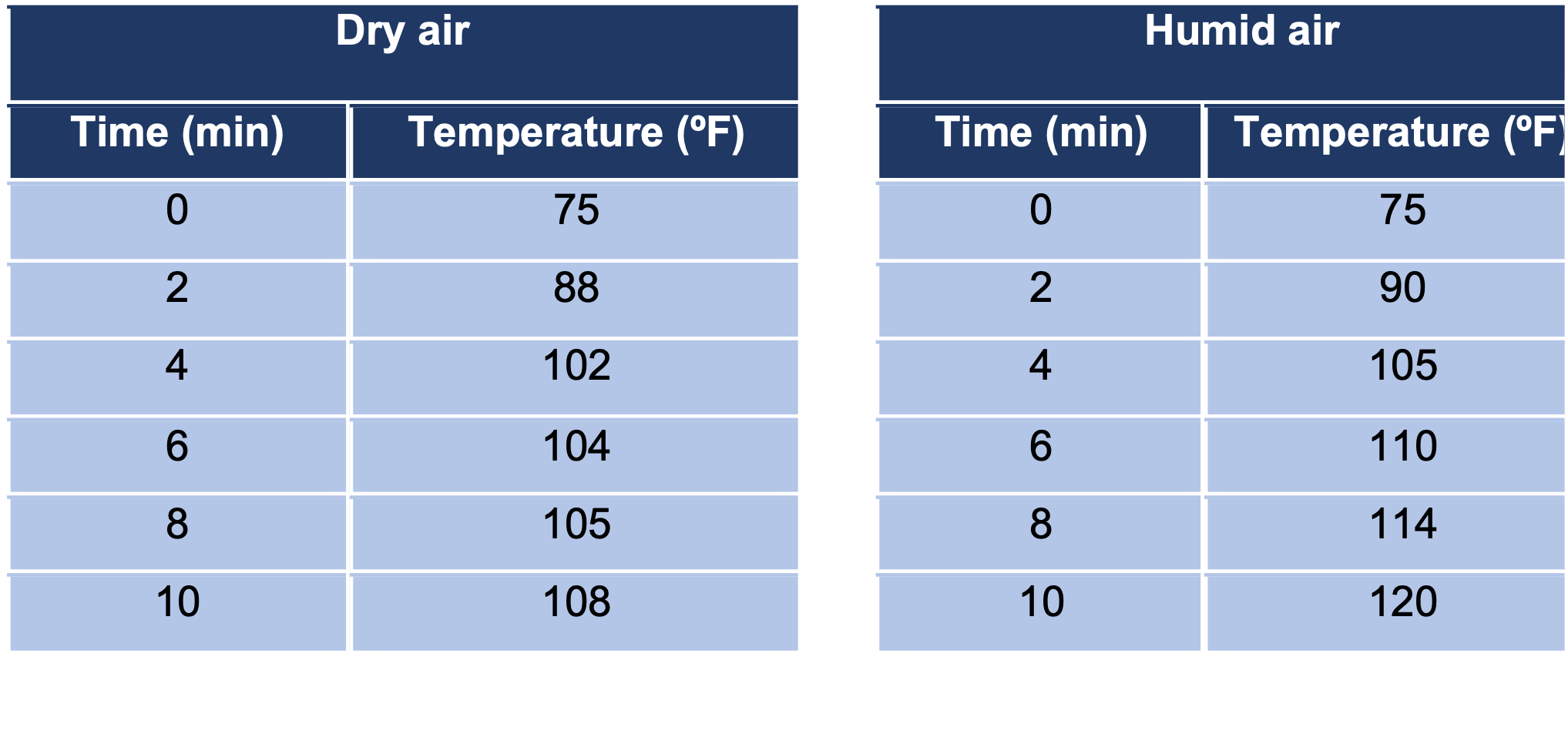
Use the results from Eunice Foote's experiments collected in the tables to draw a graph and answer the following questions.
a. For how long did Eunice Foote measure temperature?
b. Which tube reached a higher temperature?
c. What is the difference in temperature between the tubes in her last measurement?
d. Can you think of any situation in which this effect happens?
2- Later on, she repeated the experiment using a tube filled with normal air and another one with a higher concentration of CO2. She obtained the tables below. Draw the graph and answer the questions.
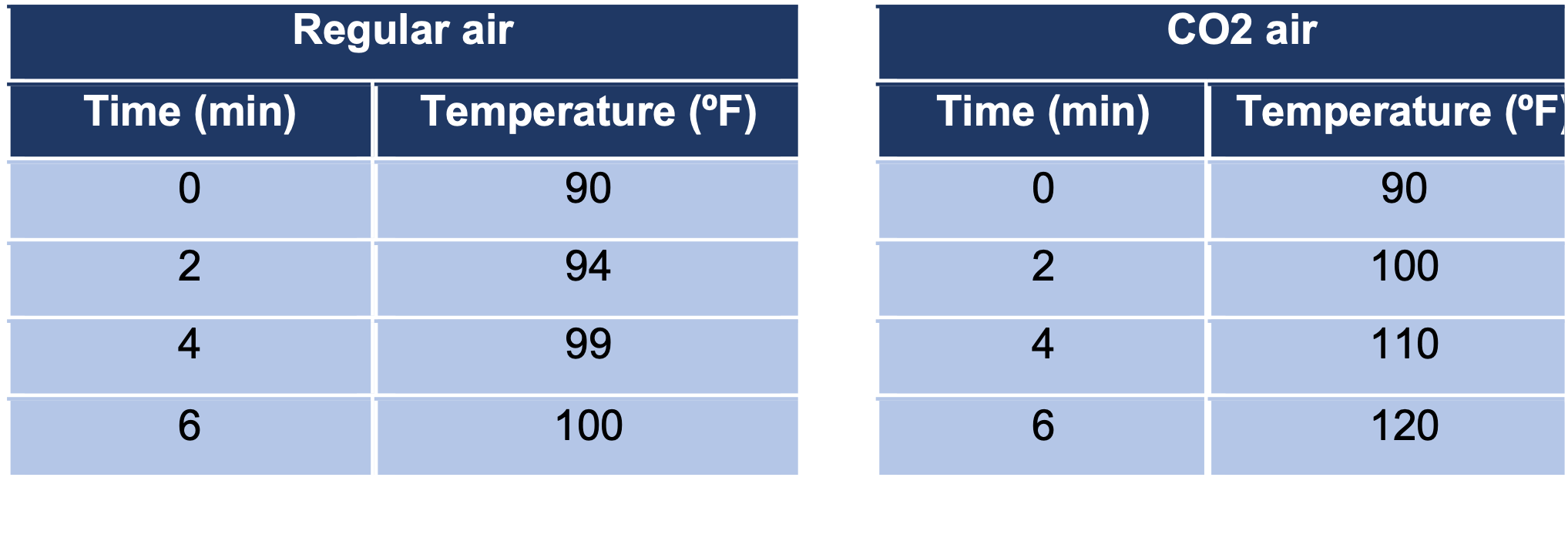
a. For how long did Eunice Foote measure temperature?
b. Which tube reached a higher temperature?
c. What is the difference in temperature between the tubes in her last measurement?
3- In 1856, Eunice went alongside her husband (a mathematician and inventor) to the American Association for the Advancement of Science (AAAS) to publish her results, but she was not allowed to read them because she was a woman. Luckily, a colleague of hers, Joseph Henry, read her article and used his speech to inform against the attitude of the association: "Science has no country or gender. Women's sphere is not only about beauty and usefulness, but also about truth" .
Using the graphs and your answers to the questions above, explain what effect CO2 has on air when it is exposed to sunlight. Pretend you are Eunice Foote, and you are given permission to talk at the AAAS.
Observaciones y contexto
- The second exercise is a role-play activity. Some students will play the role of Foote while others pretend to be Joseph Henry defending her and explaining her work, just as if they were members of the AAAS
- This activity can also be done in physics and chemistry, biology or scientific culture, and can be completed in class. It is important to highlight the simplicity of the experiment and the severity of its results.
- She was one of the signatories of the Seneca Falls Convention. She also worked as a writer, politician and teacher. She belongs to a group of scientists and activists who fought for women's rights, such as Antoinette Brown Blackwell, Darwin's critic; Ellen Swallows with environmental hygiene; and Mary Mitchell, astronomer.
- Some of her contemporaries were relevant scientists like Florence Nightingale, known for being a pioneer in modern medicine and nursing, as well as for her contributions to statistics; Ada Lovelace (1815-1852), the first person to program a machine, which preceded modern computers; and other mathematicians and professors like Mary Everest Boole (1832-1916), Sofya Kovalevskaya (1850-1891) and Charlotte Angas Scott (1858-1931).
- Many female scientists have studied climate change; Eunice Foote was particularly relevant in the study of global warming. Some current activists stand out, like [https://en.wikipedia.org/wiki/Women_in_climate_change] Gro Harlem Brundtland or, more recently, Greta Thunberg; they can both be considered Foote's successors, and so is the environmental scientist Petra Kelly or the American Julia Butterfly; in fact, Eunice Foote discovered the greenhouse effect while experimenting in her kitchen.
Descripción
In this activity we will analyse a graph representing the change in temperature inside two tubes in an experiment conceived by Eunice Newton Foote, which she used to explain what happens when there is a higher concentration of CO2 in the atmosphere.