Eleanor Antin reinterprets "Judgement of Paris"
Characters:
Theme: Main gods and goddesses of the Greek and Roman Pantheon
Competencies
Competence in Linguistic Communication
Personal, social and learning to learn competence
Competence in cultural awareness and expressions
Subjects and year by Educational System
Spain > Classical culture > 4th ESO > Continuity of cultural heritage. Mythology and religion
Enunciation

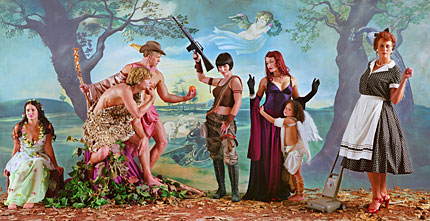
Look at Rubens' picture and the photograph of Eleanor Antin, multidisciplinary artist who reinterprets myths, and answer the questions.

EL Juicio de Paris, Rubens, Museo del Prado, 1639
https://es.wikipedia.org/wiki/Juicio_de_Paris#/media/Archivo:Peter_Paul_Rubens_115.jpg


EL Juicio de Paris, Eleanor Antin, 2007
https://d500.epimg.net/cincodias/imagenes/2014/11/11/el_puente/1415712803_141571_1415712803_noticia_normal.jpg
QUESTIONS
1.- Review the mythological episode of the Judgement of Paris and answer.
1.1. What is the reason for the episode?
1.2. What goddesses compete for the apple? Latin name, Greek name, features and attributes.
1.3. What decision does Jupiter make in that regard? Why?
1.4. What proposal does each goddess make to Paris in order to win?
1.5. Who does he choose and what will be the consequences?
2.-Look at the pictorial works at the beginning.
2.1. Find brief information about the authors.
2.2. Establish the differences between the characters in the two works and regarding the myth.
2.3. Who is the new character introduced by Eleanor Antin? What do you think she thinks or feels? Is she the master of her own destiny?
Observations and context
Miriam Schapiro creates the femmage category, a collage style that uses materials, objects and craft techniques culturally identified with women.
Judy Chicago creates The Dinner Party, a ceremonial table. On each side of the triangular table there are 13 porcelain place settings, embroidered tablecloths and the names of the 39 guests, including Sappho, Aspasia, Theodora and Hypatia. On the white tiles under the table, the names of 999 other women are inscribed including Erinna, Cleobulina, Theano, Julia Domna, Clodia, an many other Greek and Roman women.
Eleanor Antin also dynamites, with fine irony, the idealised constructions of feminity in the collective imagination that the classical world has transferred to our days.
The photograph is part of a work from the series entitled Helen's Odyssey, from 2007. There is another version of the photograph entitled Judgment of Paris (after Rubens) - Light Helen.
The photograph was part of the major exhibition at the British Museum in London, Troy: Myth and Reality, held from 21-22-2019 to 08-03-2020.
Since 2001, she has completed three series of allegorical photographs based on Roman life: The Last Days of Pompeii, Roman Allegories and Helen's Odyssey.
Description
Activity to reinforce a well-known myth and its interpretation through works of art.