How to raise children
Characters:
Theme: Greek pottery. Mythology in pottery.
Competencies
Competence in Linguistic Communication
Personal, social and learning to learn competence
Citizen Competition
Competence in cultural awareness and expressions
Subjects and year by Educational System
Spain > Classical culture > 1st ESO > Continuity of cultural heritage. Literature, art and science
Enunciation

In this exercise you will reflect on two different ways of bringing up children as shown in a Greek vase and in a letter from the Greek mathematician and Pythagorean philosopher Theano to Eubule in the 4th century BC.
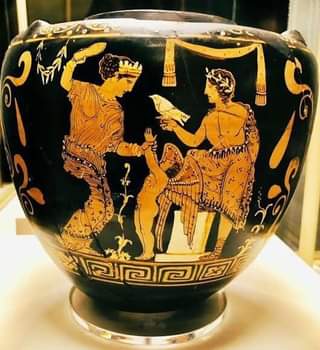
1- Pottery is one of the richest sources of information on several aspects of public and private life in Ancient Greece. Here is a vase from 360 BC, preserved in the National Archaeological Museum of Taranto (Italy), which depicts Aphrodite threatening to beat her son Eros.
1a.- Explain the difference between the two main painting techniques used in pottery: black-figure technique and red-figure technique. Which one predominates in the vase from the picture?
1b.- The vase in the picture might be a stamnos. What was it used for and how was it different from other vases?
1c.- Draw the outline of a stamnos and of four other types of Greek pottery, writing down their name and what their purpose was.
1d.- Look at the scene represented in the vase. Why do we know it is the goddess Aphrodite? What did Eros do to end up being threatened or punished by his mother? Look up information on the Internet or in a mythology book.
1e.- Do you think using "the slipper" is a good way to straighten out rebellious children and teens? Give reasons for your answer.

2- Read carefully this letter from Theano of Crotone:
From Theano to Eubule, greetings!
I hear you raise your children to live a comfortable life. However, what a good mother should do is not to fuel the pleasure of their children, but to show them the way to moderation... When pleasure interferes in the education of children, they become undisciplined...
Do not let them stuff themselves with food or indulge in all pleasures, for this is the cause of total indiscipline in children, they must not be allowed to say and try everything they want, specially if you feel worried every time they cry and you feel happy when they laugh and you smile indulgently, even if they hit their nanny or use rude words against you...
Take care of them, dear, by giving them an austere upbringing and not a comfortable life; let them be hungry and thirsty, cold and hot, let them feel embarrassed in front of their peers or keepers. In doing so, your children might grow to have a noble soul... For sacrifice, dear, is for children like a mordant that compels them to perfect their virtue...
Our own translation from Gutiérrez, Mercedes; Jufresa, Montserrat; Mier, Cristina y Pardo, Félix (1996). «Teano de Crotona», en Enrahonar, Quaderns de Filosofía, vol. 26. Barcelona: Universitat Autònoma de Barcelon. 26, pp. 95-108.
2a.- What does Theano understand as a "comfortable" upbringing and a "austere" one? Which one does she prefer? Do you agree with her that sacrifice is a stimulus that helps improve education?
2b.-Do you agree that boundaries and saying "no" are essential when bringing up children? What paragraph in the text includes this information?
2c.- Do you agree with Theano completely or do you differ in anything?
2d.- Compare the educational methods used by Aphrodite and Theano. Are they similar? Give reasons for your answer.
Observations and context
Crotone was in Theanus' time a colony of Magna Graecia.
Enheduanna (25th century BC) was a predecessor of Theano of Crotone. She is considered to be the first woman in the history of science and the first one to sign her work, in cuneiform; as well the Egyptian physician Peseshet or the Assyrian perfumers like Taputti, who paved the way for later women.
Some of Theano's contemporaries are other women in the Pythagorean school that were born around 500 BC, such as Damo, Myia and Arignote of Crotona, considered to be daughters of Theano and Pythagoras by several authors. Even though there is not much information about them, some other women belonging to this group were Babelica of Argos, Beo of Argos, Quilonis, Equecratia de Fliunte, Ecelo and Ocelo of Lucania, Habrotelia of Tarento, Cleecma, Cratesiclea, Lastenia of Arcadia, Pisirroda of Tarento, Fintis, Teadusa, Timica and Tirsenis of Sibaris.
Following Theano, we can find Aglaonice (3rd century BC, known for her ability to predict eclipses) and Hypatia (4th century AD).
The activity has been assigned to 1st of ESO, in the block of Continuity of cultural heritage. Literature, art and science. It can be adapted to other levels and can be tackled in other bocks, such as Continuity of cultural heritage. Mythology and Religion or from Classical roots of today's world. Everyday life (education).
Description
In this activity we will tackle two different ways of raising children shown in Greek pottery. Using the vase painting "Aphrodite reprimanding her son Eros with a sandal", students will reflect on one of the most traditional ways of raising children and will compare it to a letter of Theano of Crotone about the same subject.