To help or not to help.
Characters:
Theme: Estrategias de comprensión.
Competencies
Competence in Linguistic Communication
Personal, social and learning to learn competence
Citizen Competition
Competence in cultural awareness and expressions
Subjects and year by Educational System
Spain > English > 2nd ESO > Communication
Enunciation

Watch this picture and read the text by Radhika Chalasani, who photographed the famine in Sudan, and do the activities.
Read the text and answer the questions
https://www.theguardian.com/media/2012/jul/28/gutted-photographers-who-didnt-help (22/03/2022).
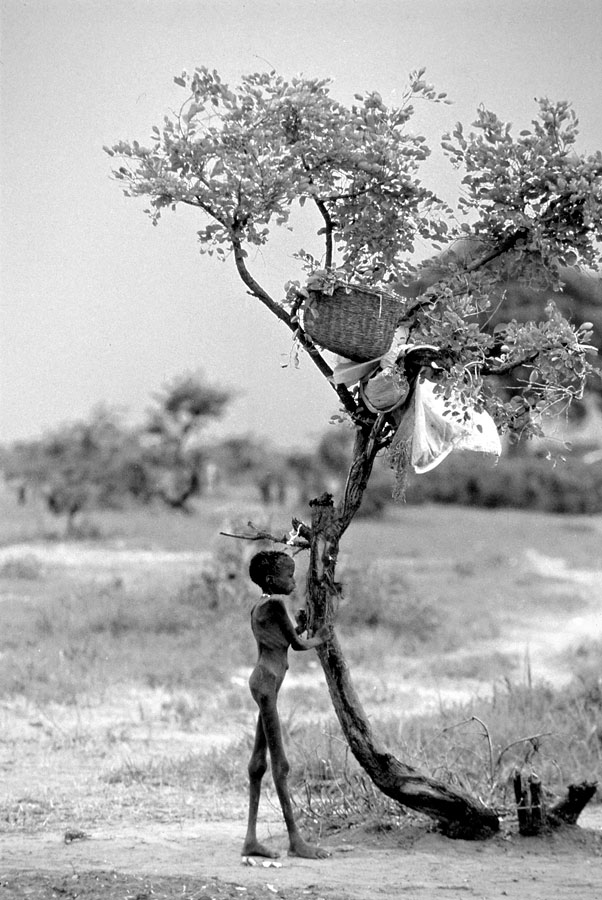
Radhika Chalasani: 'To this day, I think I didn't necessarily do the right thing'. Some photographers and journalists think that you should never interfere, because your job is as an observer. I decided a long time ago that I had to follow my conscience. I've been in very hard situations.
Some years ago, there was a great famine in Sudan. People were dying because they had nothing to eat. I was photographing a woman carrying her baby into a feeding centre. He was extremely malnourished, and I was photographing her as she walked. Suddenly, the people started directing her for the photos. They sat her down and indicated her how to hold her child. I asked for a translator, and said: 'Tell her to take her child to the feeding centre. She should not stop because I'm taking a photograph'.
Another time, there was a family sitting under a tree near the feeding centre. They couldn't walk, they were so weak. And there was a group of photographers around them. I took a few pictures, but then I walked into the feeding centre and asked a nurse: 'Is there anything you can do for this family?'.
On one occasion, a group of photographers went into an abandoned refugee camp and found a massacre. There were some children who had survived. There were two baby twins in a hut. Another photographer and I wanted to take the kids in the car. The other people said it wasn’t safe. In the end, we didn't take the children. When we found the Red Cross, we reported the situation to them.
I believe that our main contribution is trying to make people understand the stories behind the pictures. And sometimes, when you think you're helping, you're actually making a situation worse.
Questions
1. What is a feeding centre?
2. Where was the photographer working?
3. What was the problem in this country?
4. First situation
a. Who was malnourished?
b. What did the people do?
c. What did the photographer do?
5. Second situation
a.What was the family’s problem?
b. Where were they sitting?
c. What did the photographer do?
6. Third situation
a. What did the photographers find in the refugee camp?
b. What did Radhika wanted to do?
c. What did she do in the end?
7. Summarize the text in two sentences.
8. Watch more pictures of her work and debate about it.
Observations and context
- Se puede trabajar esta actividad junto con las actividades A difficult situation, referida a la fotógrafa Donna Ferrato y/o How many Pulitzers do you have?, sobre las fotógrafas Carol Guzy y Carolyn Cole, en varias sesiones, y reflexionar en las consecuencias, beneficiosas o perjudiciales, de la intervención de las personas que fotografían conflictos.
- Es conveniente distribuir al alumnado preferiblemente en grupos heterogéneos para que todos puedan participar según su nivel, ya que algunas son más sencillas y otras más difíciles.
- El trabajo de Radhika Chalasani se enmarca dentro del fotorreportaje y la fotografía de denuncia social, ya que abarca temas como la violencia contra la mujer, las catástrofes o las desastrosas consecuencias de las desigualdades sociales y la descolonización, como pueden ser las guerras y la pobreza extrema.
- Otras fotógrafas que han tratado estos temas son Donna Ferrato, Lynsey Addario o Jodi Hilton. Como ejemplo histórico, tenemos a Gerda Taro, fotógrafa de la Guerra Civil española y pionera como mujer fotógrafa de guerra.
Description
El alumnado lee el texto extraído y adaptado de un artículo del periódico The Guardian y responde a las preguntas.
Los objetivos que se persiguen son:
- Distinguir los tipos de comprensión: sentido general, información esencial y puntos principales.
- Inferir del contexto los significados de palabras y expresiones de uso menos frecuente o más específico.
- Predecir el significado de palabras desconocidas utilizando conocimientos lingüísticos.