Emerita Augusta: where stones can talk
Personajes:
Tema: Archeological remains in the Iberian Peninsula
Competencias
Competencia en Comunicación Lingüística
Competencia Plurilingüe
Competencia Personal, social y de aprender a aprender
Competencia en conciencia y expresiones culturales
Materias y cursos por Sistema Educativo
España > Latín > 4º ESO > Legado y patrimonio
Enunciado

Learn about MNAR and its story, as well as about Julia Saturnina, a Roman doctor from the 1st century AD, and two other women with different professions. Their funerary inscriptions have spoken for them.
1.- El MNAR
a.- What do these initials mean? Look up some information and write a short outline on this museum.
b.- What do you think about its building which, even if built in a modern style, was constructed using materials -brick, concrete (opus caementicium)- and techniques- basilica, arches- from Roman architecture?
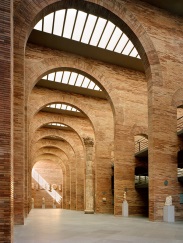
https://e00-expansion.uecdn.es/assets/multimedia/imagenes/2017/08/21/15033142492485.jpg
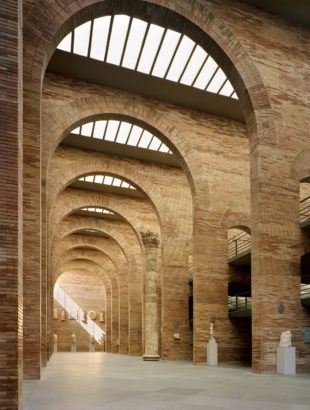
c.- What distinction was given to Merida in 1993 because of its extensive architectural catalogue, including this museum? Find some pictures of Roman monuments and choose the name of the five that have surprised you the most; the museum is likely to have pieces of all of them.
2.- Julia Saturnina
Amongst the archeological findings there are over 500 inscriptions; some of them were public, written in buildings, and others were private, mostly linked to funerary practices, such as the one of Julia Saturnina.
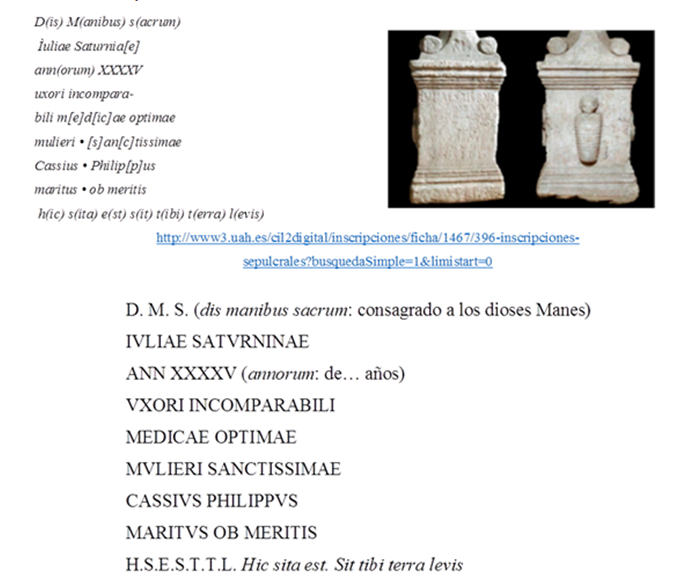
a.- Who had her inscription made and how was he related to the deceased?
b.- What case does he use?
c.- Who is the inscription dedicated to and which three of her qualities are highlighted?
d.- What case and number is used for the name and the qualities?
e.- What areas in life do these compliments refer to?
f.- Translate the last formula: Hic sita est. Sit tibi terra levis.
g.- In the inscription, you can read medicae optimae and sit tibi terra levis. Identify the transparent word and the Latinism and try to define both concepts.
h.- Take a look at the back of the funerary stela and the relief of a newborn baby. Why do you think it is shown like that? Can you guess the medical speciality of the figure?
3.- Otras mujeres
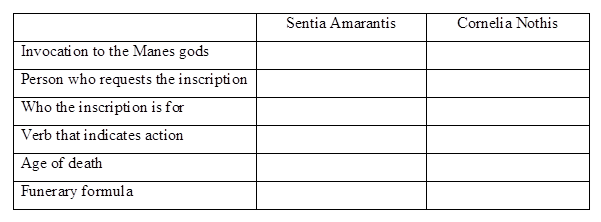
In that same museum, there are inscriptions of other women, like Sentia Amarante and Cornelia Nothis .
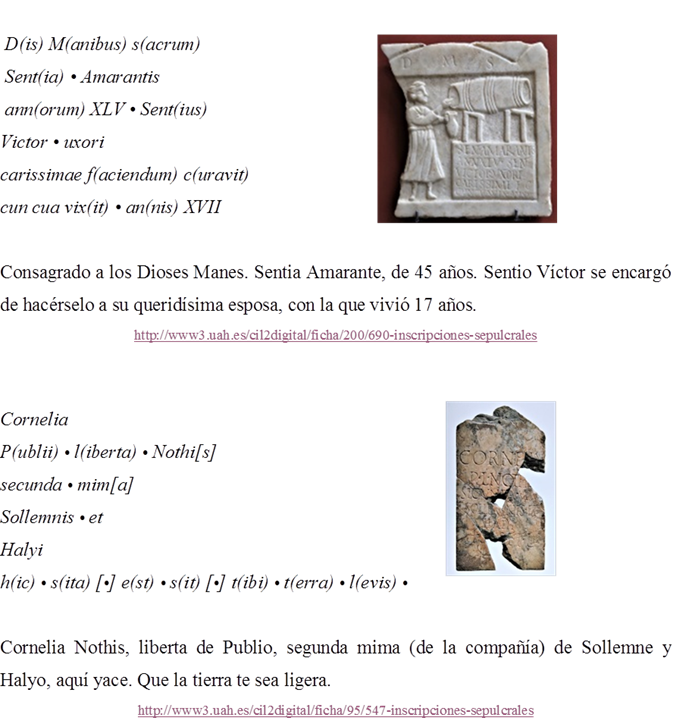
a.- What were their professions?
b.- Write down the elements of the inscription in both cases:
Observaciones y contexto
In Rome, from the testimonies of authors, we know many female physicians who also wrote treatises; this is the case of Elephantis, Lais, Olympias of Thebes, Antiochis and Metrodora. Among the women who wrote about gynaecology and obstetrics, the texts of Cleopatra and Aspasia were the most important until the work of Trocta in the 11th century.
Epigraphic testimonies also speak of Primilla, Empiria, Venuleya Sosis, who appear as medici; Salustia Ateneis, as obstetrix; Naevia Clara, as medicaphilologa, and Aurelia Alexandra Zózima, "for her medical knowledge".
Funerary inscriptions show Metilia Donata in Lugdunum, Asyllia Polla in Carthago, Naevia Clara in Rome, Scantia Redempta in Capua and Julia Saturnina in Emerita Augusta.
Descripción
Researching and reflecting on the National Museum of Roman Art (MNAR) in Spain. Learning about Julia Saturnina and other two women through the inscriptions that belong to the museum's collections.