Mary of Alexandria and the bain-marie
Personatges:
Tema: The material systems
Competències
Competència en Comunicació Lingüística
Competència Matemàtica, en ciència, tecnologia i enginyeria
Competència personal, social i aprendre a aprendre
Matèries i cursos per Sistema Educatiu
Espanya > Física i Química > 2n ESO > La matèria
Enunciat

We are going to carry out a laboratory experiment using the induced heat method, the bain marie, which is very important both in the chemical laboratory and in the kitchen. The bain marie is a method of slowly heating a substance by immersing the container in a larger vessel containing water or another liquid and bringing it to the boiling point. This method of heating substances was invented by one of the great scientists of antiquity, Mary of Alexandria, in the 2nd century BCE. This and her other contributions are still in use in the 21st century.
Let's put it into practice, and observe the changes that occur in a pure substance and measure the variation in its temperature.
1) Take a small amount of ice and place it in a beaker with a thermometer as shown in the figure. Write down the initial temperature.
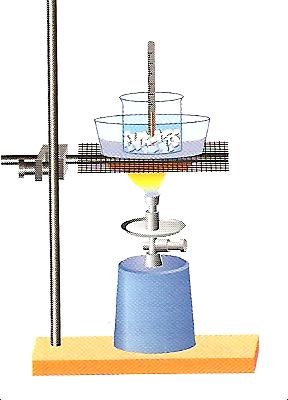
2) Heat in a bain marie (by placing the cup of ice in another container of water) and record the temperature every minute.
3) Fill in a table with the temperature values per minute and the state of the ice: solid (ice), solid-liquid, liquid (water).
|
Time in minutes |
0 |
1 |
2 |
3 |
4 |
5 |
6 |
7 |
8 |
| Temperature (°C) | |||||||||
|
Ice state: solid (ice), solid-liquid, liquid |
4) Answer the following questions:
- What happens to the temperature in the first few minutes before the ice starts to melt?
- What temperature do we record while we have a mixture of ice (solid water) and liquid water?
- What happens to the temperature during the time ice is melting, i.e. becomes liquid (water)?
- What happens to the temperature when there is no more ice in the beaker and we continue heating?
- How is called the temperature at which a substance changes from solid to liquid state
5) Draw conclusions (fill in the dotted lines):
The temperature at which a substance changes from a solid to a liquid state (melting process) is called ................................... and is equal to the solidification temperature (when a substance changes from a liquid to a solid state). For the duration of the change of state, the temperature ..........................................
Observacions i context
context of feminine creation
The most original and outstanding scientist of antiquity is in the tradition of alchemy. She was the one who initiated empirical alchemy, which had illustrious successors, such as Cleopatra, 3rd century, who wrote Chrysopoeia (Making Gold), but who above all brought the value of experimentation to the alchemical tradition, making it an experimental tradition.
With Cleopatra, however, this tradition came to an end. Alchemy arrived in the Middle Ages as mystical gibberish. Marie is the heir of perfumers such as Taputti Bellatekalim, from 1200 BC, and her empirical alchemical proposals (which led her to create instruments and use glass) have later heirs such as Caterina Sforza (1463-1509), Marie de Gournay (1565-1645) or Caterina Vitale in the 16th century, pharmacist of the Sacred Infirmary of Malta, Marie Meurdrac (1610-1680), almost pointing to the birth of chemistry with the Lavoisier couple.
Some of the most famous Roman doctors were also their contemporaries, such as Metrodora (200-400), of whom we have a treatise on women's diseases and care, Antiochis of Tlos (1st century BC), a specialist in spleen and arthritic diseases and a friend of Galen (129-216), Elephantis (1st century BC), Lais or Aspasia of Miletus (c. 470 BC - c. 400 BC) and Cleopatra, the last two being the most outstanding. Before them we find Olympias of Thebes, a specialist in preventing miscarriages and inducing labour with mallow and goose fat. These doctors had a professional status that should be emphasised. The Empress Julia Domna (c. 170-217) was also a contemporary, noted for her knowledge of science and philosophy, ruling alongside her husband and maintaining a salon attended by Galen (129-c. 216) and Diogenes Laertius (3rd century), among others. She also had an illustrious and battle-hardened contemporary in Zenobia of Palmyra (c. 240-c. 274), who bravely faced the Roman legions. Nevertheless, the bain-marie, the black marie, glass in the laboratory, instruments such as the tribikos and above all the kerotakis, as well as her zeal for empirical verification (which took centuries to recover), make her one of the great scientists of antiquity.
Descripció
To carry out an experiment using the water bath of Mary of Alexandria. To find the melting temperature of a pure substance.