Geography in feminine
Characters:
- Praxilla of Sicyon [en] [es] [cat]
- Sappho of Lesbos; (Sappho of Mytilene) [en] [es] [cat]
- Telesilla of Argos [en] [es] [cat]
- Erinna of Telos [en] [es] [cat]
- Corinna of Tanagra [en] [es] [cat]
Theme: Geographical frame for the Roman and Greek civilizations at their cultural peak.
Competencies
Competence in Linguistic Communication
Personal, social and learning to learn competence
Competence in cultural awareness and expressions
Subjects and year by Educational System
Spain > Classical culture > 1st ESO > Classical roots of today's world. Geographical framework of Greece and Rome
Enunciation

You are going to meet the nine poetesses that belong to what is considered to be the "first feminine literary canon". Antipater of Thessalonica gathered them in an epigram that he supposedly wrote and called them "the nine Muses".
1- Extract from the epigram the name of the ten poetesses and write a list in your notebook.
EPIGRAM / FIRST "CANON" OF FEMININE POETRY
This epigram is not a catalogue of all Greek female writers, because these poetesses were not the only women to write in Ancient Greece. For this reason, the canon assesses and selects from the catalogue. Just like the heavenly muses were raised at the foot of Mount Helicon, the divine inspiration of these poetesses is the cornerstone that the author uses to claim that they were also fed at Pieria, that is, that they were also muses.
These are the divine-voiced women that were fed with songs,
by Helicon and the Macedonian hill of Pieria:
Praxilla, Moero, the mouth of Anyte, the female Homer,
Sappho, glory of the beautiful, curly-haired Lesbian women,
Erinna, renowned Telesilla, and you Corinna,
who sang the military shield of Athena,
female-tonged Nossis, and sweet-sounding Myrtis,
all craftswomen of eternal pages.
Great Ouranos gave birth to nine Muses, and these nine
Gaia bore, deathless delight for mortals.
(AP IX 26)
Fernández Robbio, Matías Sebastián (2014). «Musas y escritoras: el primer canon de la literatura femenina de la Grecia antigua (AP IX 26)», en Praesentia 15, (retrevied on 05/04/2022)
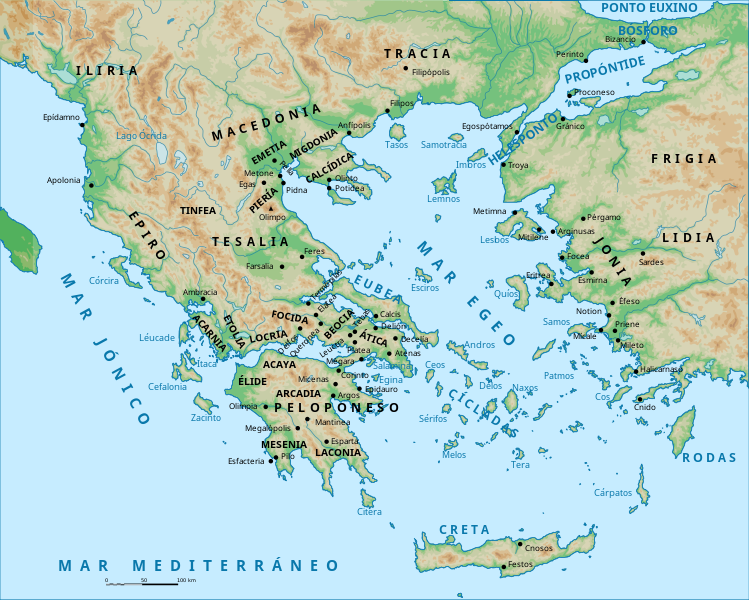
2- Based on the information in the table, find their places of origin in the map.
The authors cited lived between the 7th and 3rd centuries BC. None of them was from Athens, they were from distant regions such as Byzantium in ancient Ionia or Locri in Magna Graecia:




3- Cut out the pictures and stick them in the corresponding place in the map.

4- Look at the timeline and Answer the questions:

a- Who is the only poetess from Classical Greece?
b- Where is she from?
c- Is it far or close to Athens?
d- Is there any poetess from Athens?
e- What do you think is the reason for this?
Observations and context
Praxilla, Erinna, Myrtis, Anyte, Telesilla, Nossis and Corinna, among others, were famous enough to have statues erected in their honour. (Tat. Oratio ad Graecos, 33). Other authors mention these poetesses and others by citing their works or their fame (Eust., Comm. ad Hom. Iliad. B 711, v. 1 - 510.4; Clem. Alex. Strom. IV 19 122 4).
The amount of poetesses chosen by Antipater is not by chance: there were nine muses and nine male lyrical poets in the canon. Here lies the originality of this feminine "canon" created at the end of the 1st century BC or at the beginning of the 1st century DC. Each canon is presented as a harmoniously structured unit. However, unlike the others, this is not a canon based on literary genre, but on the gender of its authors. In that sense, this epigram answers the Alexandrine canon of nine lyrical poets by offering an alternative one formed by authors of the opposite gender, whose works tackled different (literary) genres.
Fernández Robbio, Matías Sebastián (2014). «Musas y escritoras: el primer canon de la literatura femenina de la Grecia antigua (AP IX 26)», en Praesentia 15, p. 1 /9
This activity is in relation to each and every one of the nine poetesses. It has been thought fort the 1st year of ESO, but this does not mean that it cannot be used in other levels in the subject of Classical Culture, in the same block of contents, if the teacher considers so.
Description
This activity focuses on situating geographically the places of origin of the lyrical poetesses that belong to the feminine "canon" as well as their timeline. Reading texts, selecting information and situating them in time and space.