Other places, other women
Characters:
Theme: The Second Persian invasion of Greece
Competencies
Competence in Linguistic Communication
Personal, social and learning to learn competence
Competence in cultural awareness and expressions
Subjects and year by Educational System
Spain > Classical culture > 4th ESO > Classical roots of today's world. History and socio-political evolution
Enunciation

Artemisia of Halicarnassus was born in the city currently known as Bodrum (Turkey), and was the tyrant of the region of Caria (Asia Minor). She commanded a small fleet of five ships with which she joined the Persian army of the Great King Xerxes I in his expedition against the Greeks in the Second Persian invasion of Greece. She fought at the head of her troops and led them in the battles of Artemisium and Salamis.
Read the text and answer the questions.
Ironically, the city that created the democratic system, Athens, was also the city that had the worst regard for women. For the Athenians, the perfect archetype of a woman was one who remained within the walls of her home, taking care not only of her property, but also of her husband and children, so that her education was restricted to those disciplines that were useful for life, always taught by the other women in the family. The Athenian woman who stepped out of this male-imposed role was vilified and reviled even in theatrical plays.
This was not the case in other Greek regions or cities, where women enjoyed greater freedom. It is true that only those belonging to the aristocracy had access to education, but even so, they had more scope for action than Athenian women. This is the case of the region of Ionia and the Greek cities of the Asian coastal strip, where Artemisia of Halicarnassus (or Artemisia I of Caria) comes from, but also many other famous women such as Artemisia II of Caria, descendant of the previous one, Sappho of Lesbos, Aspasia of Miletus, Thargelia of Miletus or Themista of Lampsacus, among others
- Discussion: The role of women in Athens versus elsewhere in Greece. Comparison with the present.
As a starting point, we can use the following text from the work entitled Safo ante la crítica moderna, written by a Spanish author of the 19th century:
Lesbos seems to have been a particularly free place for women: "in heroic societies, we always see women enjoying equal rights and pre-eminence with men, we see them fulfilling the same duties, and this must be attributed to the fact that in the first drafts of a town the home life is not defined, and therefore, the true and just end that women should perform is not determined [...] and it is known that the Aeolians from the beginning distinguished women with more rights than other peoples, that these rights always existed or at least were only denied after a long time". (Antonio Fernández Merino, Safo ante la crítica moderna)
- Look up information about these women and explain what they are known for.
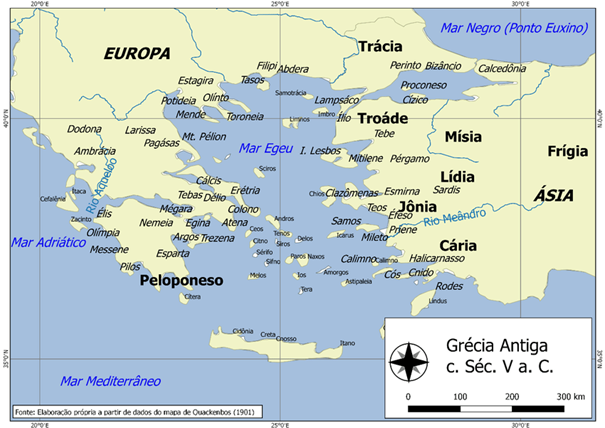
- Locate on the map the place of birth of each of them and mark it. Additionally, mark the coastal strip of Asia, the region of Ionia and the city of Athens.
Observations and context
Other famous rulers were Artemisia II (4th century BC), who, when widowed by her husband Mausolus of Caria (377 – 353 BC), ordered the construction of a grandiose and spectacular funerary monument in his honor, considered one of the seven wonders of Antiquity: the Mausoleum of Halicarnassus; Cleopatra Philopator (1st century BC), queen of Egypt, or Zenobia of Palmyra (3rd century AD). Of these, Cleopatra and Zenobia also commanded their armies, in this case against the Romans, and they were joined by others, such as Boudica, queen of the Iceni, who led several British tribes against the Romans.
The activity could also be done in 1st and 3rd ESO in the same content Block, or in the Classical Roots of the Modern World block. Everyday life.
Description
First of all, a discussion on the role of women in ancient Greece is proposed, comparing the situation in different regions and with the present day. As a starting point, we can use the fragment extracted from the work of Antonio Fernández Merino, Safo ante la crítica moderna. Later on, and also based on the same fragment, the students are asked to do some research on other women who were born in the same region as Artemisia and who dedicated themselves to very different activities.
Data collection, reflection, information search.