Julia Domna, the Syrian Empress
Characters:
Theme: The Empire
Competencies
Competence in Linguistic Communication
Personal, social and learning to learn competence
Competence in cultural awareness and expressions
Subjects and year by Educational System
Spain > Latin > 4th ESO > The present of the Latin civilization
Enunciation

Look at this painting of the family of Empress Julia Domna and answer the questions.

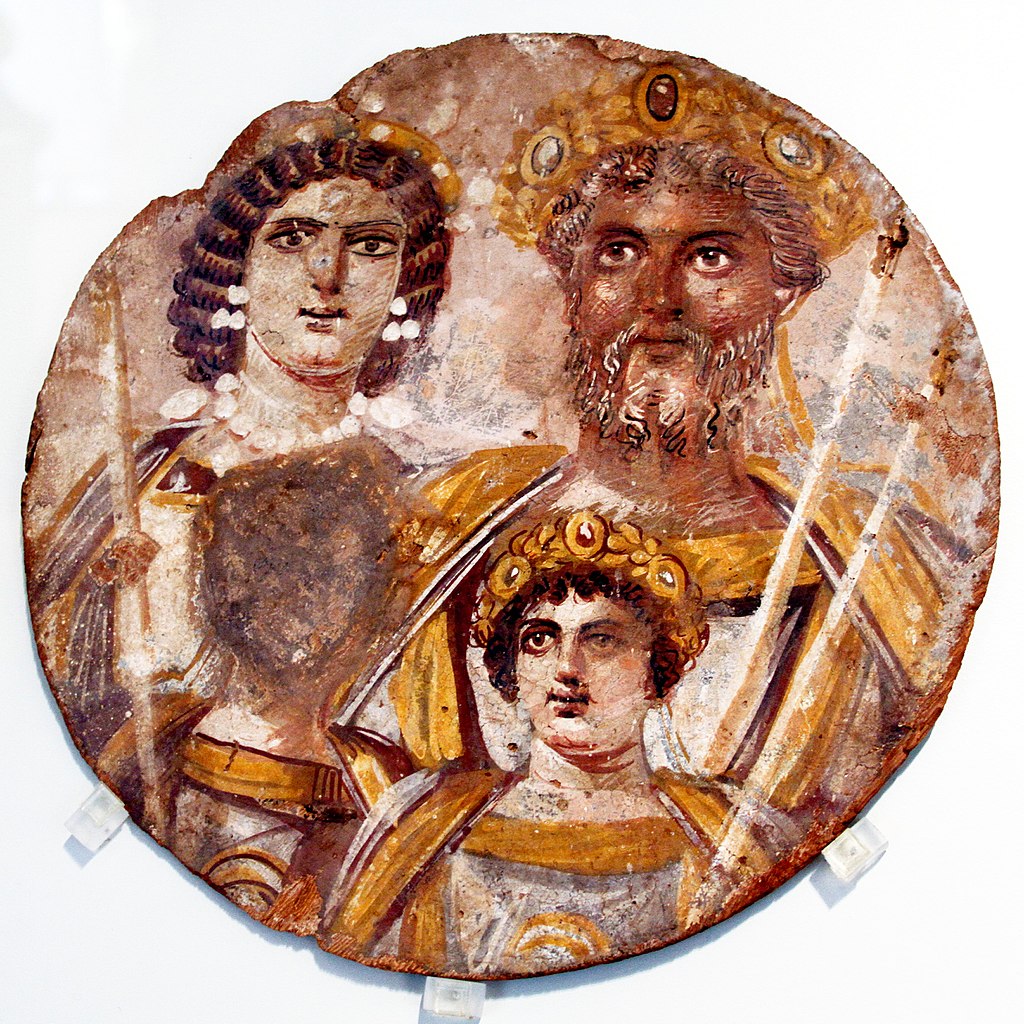
1.- What dynasty did this family start? Who are its members? What was the previous dynasty?
2.- What elements do the characters share? Do they seem equally important?
3.- Look up the meaning of the words tondo and damnatio memoriae, related to the painting.
4.- Which character is erased? What is the reason?
5.- Find out how the empress Julia Domna was related to Julia Maesa, Julia Soaemias and Julia Mamaea and which emperors they contributed to the Empire. Why have they been called "Syrian empresses"?
6.- Julia Domna felt admiration for the queens Semiramis and Nitocris. When her son died, she tried to rule alone and, when this turned to be impossible, she decided to die of starvation. Did she have political ambition?
7.- In addition to her political power, Julia Domna has been called "the philosopher" and has been compared to Aspasia of Miletus. In which period and city did this woman live? Which fields did she excel in?
8.- The important position denoted by Julia Domna in the public sphere arises from the lavish designation of Iulia pia felix Augusta mater Augusti nostri et castrorum et senatus et patriae. In which contexts was authority granted to her?
Observations and context
The women of the Severan dynasty offer an interesting profile of autonomy and independence that brings them closer to those of the Julio-Claudian dynasty. Along with Julia Domna, other prominent Syrian princesses are her sister Julia Maesa and the daughters of the latter, Julia Soaemias and Julia Mamaea. These Syrian women were owners of power and of Rome. Julia Maesa, Soaemias and Julia Mamaea ruled while Elagabalus dedicated himself to impose the cult of the sun god in Emesa. But Julia Maesa, who enthroned Elagabalus, determined his fall and murder, seeking the rise to power of her other grandson, Alexander. When he was named emperor, the two Julias (grandmother and mother) took charge of the state. After Julia Maesa's death, Julia Mamaea took over the power, which she exercised on her own.
Description
Commentary on a painting of the family of the Empress Julia Domna.