Character
Retrato

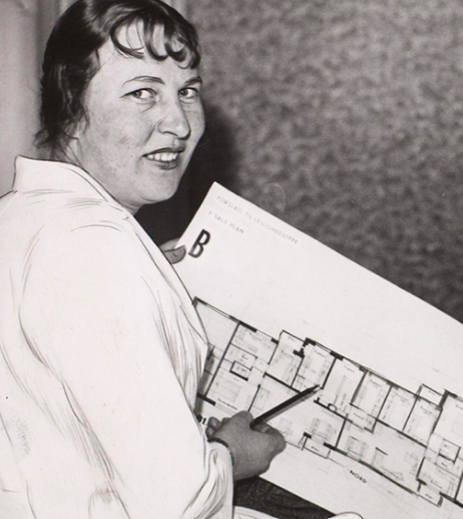
Ragna Grubb

Copenhague, 20-03-1903 — Frederiksberg, 09-06-1961  

Period of activity: 1933 — 1951

Geographical classification: Europe > Denmark

Socio-cultural movements

Late modern period / Contemporary period > Artistic movements since the end of the 19th century > Post-war art

Late modern period / Contemporary period > Artistic movements since the end of the 19th century > Art from the first third of the 20th century

Late modern period / Contemporary period > Artistic movements since the end of the 19th century > Rationalist architecture / Modern movement

Historical milestones > Interwar period

Historical milestones > World War II

Historical milestones > Aftermath of World War II

Historical milestones > World War I

Groups by dedication

Technologists > Architects

Context of feminine creation

Between the years 1925 and 1975, Danish society went through some significant changes, including a change in the role of women.


In 1915 women were given the right to vote and in the coming years, the first generations of women would become graduates in design, a field that was gaining ground in Europe, with the Bauhaus School at the helm. This was a school which took a broad international approach to design and that welcomed the participation of women.


 Between 1925 and 1975, women such as Ragna Grubb (Social Housing), Grethe Mayer (Industrial Design), Anne Marie Rubin (Urban Planning) or even the current contemporary architect Lene Tranberg along with others, made an important impact by reshaping everyday living. Between them all they would design and reinvent kitchen spaces, public buildings, housing, landscapes, public areas, and much more.


Their works have reshaped the everyday life of the Danish people, but yet they went unnoticed.


Review

The name Ragna Grubb may not ring a bell with most Danish people, but her work as an architect has played an important role in the cultural history of Denmark given that her ideas established a new set of standards for the inhabitants of Copenhagen to live by.

Activities

Justifications

  • An architect who showed a keen interest in social housing in the 1930s.
  • She was the first woman to win an architecture competition in Denmark.
  • She set new standards for Danish social architecture.

Biography

Ragna Grubb was born in Copenhagen in 1903 and displayed an interest in architecture from a very young age. However, it wasn’t until 1922, after discovering classical architecture on a trip to Switzerland and Italy, that she decided to enrol in the Copenhagen Technical School to complete her studies and thus be able to access architectural studies.  She was accepted into the Danish Royal Academy of Fine Arts just a year later, gaining her degree in architecture in 1933.


During her years as a student, she carried out placements in the studios of Povl Baumann, Knud Sørensen and Kaj Gottlob, an architect who another Danish pioneer, Karen Clemmensen, would also intern with.


Winning first prize in an architecture competition for  Kvindernes Bygning (The Women’s House) allowed her to open her own architectural studio in 1935, something almost unthought of for a woman at that time.


This building, that would later become a recognized work, was the headquarters of a female institution built to serve as a meeting point for female associations and groups linked with social causes.


Social housing was always Ragna Grubbs’ passion throughout the whole of her career. In 1937, along with another two architects, Karen Hvistendahl and Ingeborg Schmidt, Ragna won the competition launched by Foreningen Socialt Boligbyggeri-FSB (Copenhagen Social Housing Association), for the design of the social housing scheme Kantorparken: housing created for large families with limited resources.


From 1937 onwards, after her marriage to fellow architect Christian Laursen, her professional life slowed down as she became a mother and prioritised her home life. Her works were mainly single-family homes and renovation pieces. In 1951, she received with her husband the Copenhagen City Council Award for restoring a historic building and converting it into the headquarters of H. Struers Chemiske’s Laboratories.


Ragna Grubb was invited to showcase her work on two occasions (1939 and 1941) at the Charlottenborg Forarsudstilling (Charlottenborg Spring Exhibition), one of the main exhibition events within Northern Europe.


Works


The Women’s House (1935)

Block 7 within the Social Housing Scheme Kantorparken (1937)

Building for H. Struers Chemiske Laboratories (1951)

Didactic approach

Design

Architecture

Social Housing

Urban Planning

Technology

Documents