Who is who
Personajes:
Tema: Main gods and goddesses of the Greco-Latin pantheon
Competencias
Competencia en Comunicación Lingüística
Competencia Personal, social y de aprender a aprender
Competencia en conciencia y expresiones culturales
Materias y cursos por Sistema Educativo
España > Cultura Clásica > 3º ESO > Continuidad del patrimonio cultural. Mitología y religión
Enunciado

Timarete was born in Athens during the 5th century BC and she was the daughter of Micon of Athens, a painter and sculptor of some works related to the Olympic Games of antiquity. She made a panel painting of the goddess Artemis, which was preserved for many years in the temple of this deity in Ephesus. The image was taken out during processions in the festivities dedicated to the goddess.
The Ephesian Artemis presents differences and similarities to the Olympian goddess Artemis. To establish them, read carefully their respective descriptions and answer.
Artemis of Ephesus
The oldest image of the Ephesian Artemis must have been a xoanon, that is, an effigy carved on a tree trunk and, later on, perhaps on a stone of meteoritic origin, so that sometimes, as in the case of the Cybele of Pessinus, it was described as a diopetés, that is to say, “fallen from the sky”. As a cult statue, it always maintained its rigid appearance from the waist up.
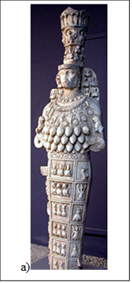
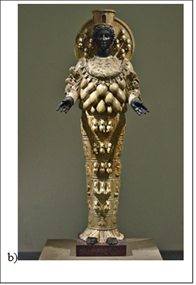
Her iconography is known to us from coins and, above all, from three sculptures: Artemis the Great, Artemis the Beautiful (Istanbul Museum, found in Ephesus) and Artemis Farnesia (Naples Museum).
The globular peduncles that cover part of her chest and waist respond to the prototype of the so-called Polymastic Artemis, one of "multiple breasts", because until recently these protuberances were interpreted as breasts and, therefore, unequivocal symbols of fecundity of the goddess, who was associated with fertility. Currently, and based on the lack of nipples, iconographic criticism relates the protuberances to the representation of the testicles of bovids that were sacrificed at the festivals held in her honor. Another recent theory relates such protuberances to the representation of bunches of dates, since the palm tree was the sacred tree that Leto was grabbing while she give birth to Artemis and, therefore, they were always linked to the cult of this goddess.
Artemis the Great, 1st century AD. Asian style: very ornate headdress and complex decoration. Marble.
Artemis the Beautiful: beginning of the 2nd century AD. She is not wearing a headdress. Accompanied by two deer whose leg rest on an omphallus. Marble.
Farnese Artemis. Bronze. The material from which it is made recalls that its original had the same parts carved in dark stone, possibly from a meteorite. She wears a headdress in the form of a kalathos (a basket), in which city gates are represented.
The three representations have some essential aspects in common: the goddess, in addition to the globular protuberances up to the waist, has representations of animals, people and plants all over her body and, behind her neck, the lunar disk. Artemis the Beautiful also presents the circle of the horoscope represented in the lunar disk.
(Translated from the article by Pilar González Serrano, Professor of Archeology at the Complutense University of Madrid. “Consideraciones iconográficas sobre la Ártemis Efesia.”)
Olympian Artemis
Artemis is one of the oldest divinities in the Greek pantheon and, precisely for this reason, she is one of the most revered in the entire Mediterranean. Artemis is a goddess with two fundamental facets. She is, on the one hand, a female goddess who does not tolerate contact with men, which is why in many places her worship is restricted to women. On the other hand, she is a wild and rugged goddess, protective deity of hunting, beasts and spaces not altered by man. For this reason, on many occasions her worship is carried out outside the cities, the urban world being totally alien to the influences of this goddess. The Greeks imagined Artemis as a virgin maiden dressed in comfortable clothes to wander the fields, armed with a bow and arrows and accompanied by various animals.
Artemis was the daughter of Zeus and Leto. Upon discovering the new infidelity of her husband, the goddess Hera threatened to unleash her anger on the land that welcomed Leto to give birth. The young woman then began a long pilgrimage that ended on the wandering island of Delos, a place that constantly changed position in the sea and, therefore, could escape Hera's revenge. On this island, Leto gave birth to twins: Apollo and Artemis. She was born first, at the foot of a palm tree that her mother had clung to to help her give birth. Then, she helped with the birth of her brother.
Zeus, grateful, fixed the island of Delos in the Ocean and protected it from Hera's reprisals. The island ended up being consecrated to the cult of Apollo and became one of the most important sanctuaries of this god. According to some myths, Artemis asked Zeus to allow her to remain a virgin and to be able to live in the woods, dedicating herself to hunting with a group of companions, nymphs and dryads, as an entourage. Later, Artemis asked Hephaestus to make her a bow and arrows with which she could hunt. Finally, the god Pan gave her a pack of canines to accompany her.
Look at the pictures and identify them
c) 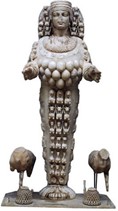 d)
d) 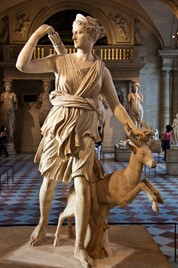
Answer:
- Which of the two goddesses is the twin of the god Apollo?
- Who are the parents of the Olympian goddess?
- How would you notice that the original image of Artemis from Ephesus was carved on a tree trunk?
- Observing the images, what would you say they are goddesses of?
What do you see in the image?
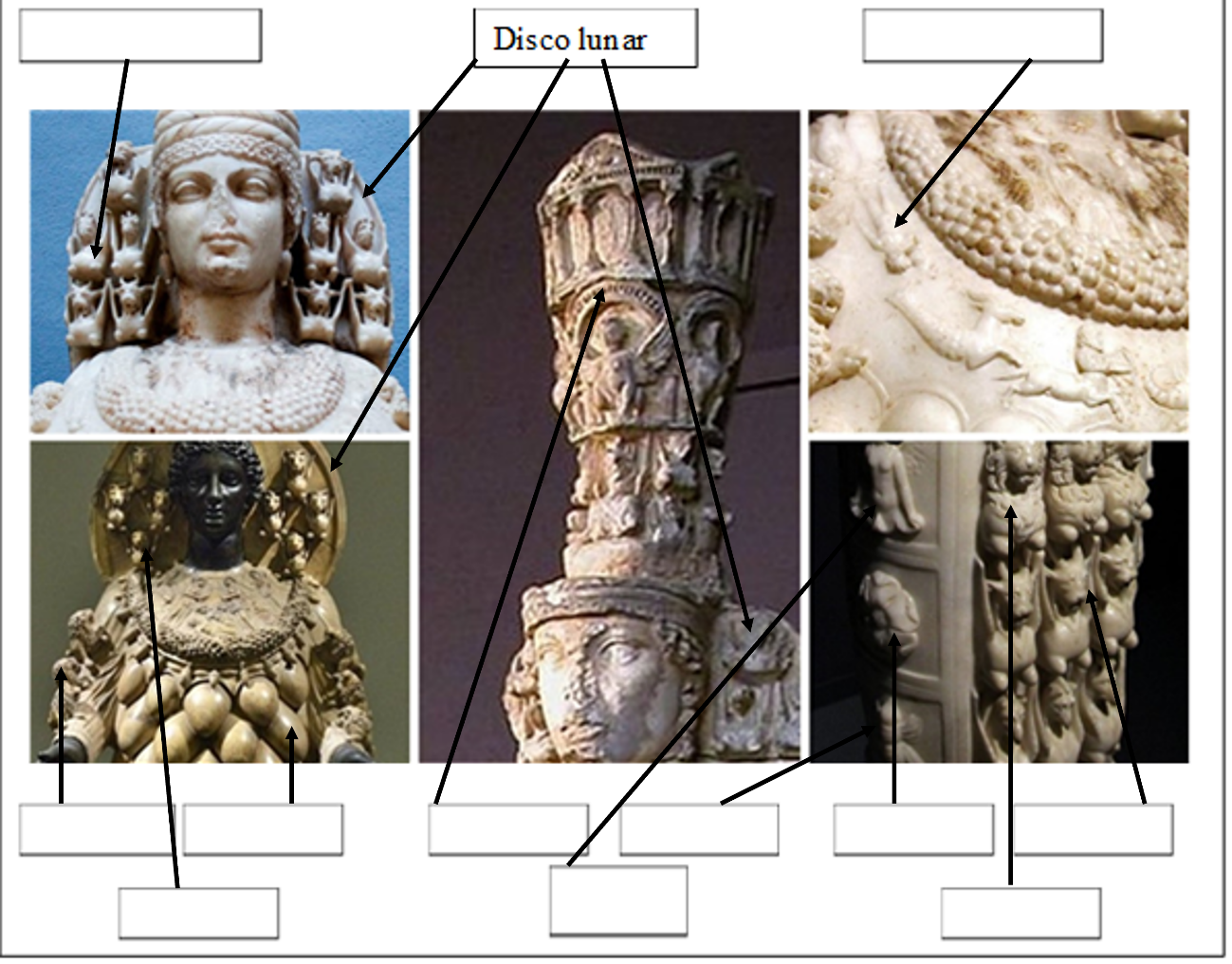
- Griffins
- Bulls
- Lions
- Bees
- Winged victory
- Tiara or headdress
- Horoscope circle
- Flower
- Moon disc
- Breasts, bull testicles or dates
Observaciones y contexto
Timarete is, as the sources make us understand, part of a small number of female artists, including painters and sculptors: Anaxandra, Alcisthene, Aristarete, Calypso, Iaia of Cyzicus, Helen of Egypt and Olympia. She is one of the 999 women from The Heritage Floor featured in Judy Chicago's The Dinner Party (1979). In this work, her name is associated with that of the poet Sappho of Lesbos, who at the same time is represented as one of the 39 women seated in Wing I of the installations’ table.
Artemis of Ephesus is a deity resulting from syncretism with other deities: the Phrygian Mother Goddess Cybele, the Cretan Potnia Theron, "Mistress of the beasts", and the Olympian daughter of Zeus and sister of Apollo, Artemis, who, in turn, eventually identified with Selene, the Greek goddess of the moon, and the Potnia Theron. The original form of Cybele −Cybele of Pessinus− was a baetylus, a black stone of meteoric origin. In fact, that's what her name Kybele means, "fallen from the sky". Also the Ephesian Artemis, whose first representation was most likely a xoanon, was represented by a black meteorite stone. These are not the only cases in which a black stone of celestial origin is worshipped: the Islamic religion does the same with a stone located in the Kaaba.
Timarete's work has not reached us, but we know of her through literary sources. It was an image of the goddess Artemis, painted on wood, and kept in the temple of the goddess in the Ionian city of Ephesus. The Artemis painted by Timarete apparently has nothing to do with the Olympian Artemis.
The activity has been assigned to 3rd of ESO, specifically related to the Block Continuity of Cultural Heritage. Mythology and Religion, but it could also be used in the Block Continuity of cultural heritage. Literature, Art and Science, as well as in 1st, 2nd and 4th of ESO, in the same blocks of content.
Descripción
With this activity, it is intended to establish the similarities and differences between the two dedications of the same goddess Artemis (the Ephesian and the Olympian), attending to the attributes of each one of them and the description of their representations in plastic arts.