Locations of the conflict (Peloponnesian War)
Personatges:
Tema: Greece: from the Classical period to Hellenism. Relevant historic events.
Competències
Competència en Comunicació Lingüística
Competència personal, social i aprendre a aprendre
Competència en consciència i expressions culturals
Matèries i cursos per Sistema Educatiu
Espanya > Cultura Clàssica > 3r ESO > Arrels clàssiques del món actual. Marc geogràfic de Grècia i Roma
Enunciat

Aspasia, born in Miletus ca. 470 BC, was a cultured and intelligent woman that surrounded herself with influential figures of the political and cultural spheres; she was an active participant of both spheres in 5th century BC Athens. She was a teacher of rhetoric and wrote speeches for her partner Pericles, according to some historians.
Aristophanes accused Aspasia of being responsible for the Peloponnesian war in his comedy The Archanians. You are going to read a summary of this relevant military conflict in Greek history and look at some maps showing the locations where it took place.
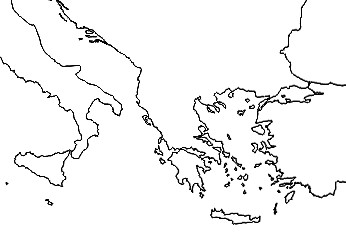
Read and place on the map the most important fields of battle in this war.
I- Read the SUMMARY and underline the names of the places where there was a battle.

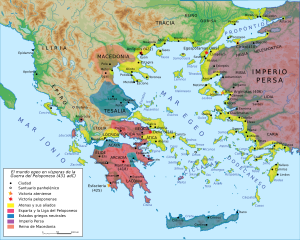
The Peloponnesian War (431 - 404 BC) was a military conflict in Ancient Greece that confronted the cities of the Delian League (led by Athens) and the Peloponnesian League (led by Sparta). Sparta started war on Athens because "they were afraid that the Athenians would become more powerful, considering that most of Greece was under Athens' control". (Tucídides, Historia de la guerra del Peloponeso, book one, section 23)
There are two events that led to resuming the war after breaking the Thirty Year Peace signed in 446/445 BC.:
-The war between Corinth and Cocyra and the desertion of Potidaea, a colony of Athens:
- Corinth intervened in the civil war between democrats and oligarchs in Epidamnos, one of their colonies. The oligarchs asked Cocyra for help. Naval battle in the promontory of Leucimna; battle of the islands of Sybota (Cocyra).
- Battle of Potidaea
Two significant events triggered the outbreak of the war:
- Athenian decree against Megara
- Extraordinary increase of Athenian power
Historians have divided the war into three stages:
1- Archidamian War: Sparta repeatedly invaded Attica, while Athens took advantage of their naval supremacy to attack the Peloponnesian shores (Battle of Naupaktos) and tried to extinguish any sign of unease in their empire. This stage of war concluded in 421 BC with the Peace of Nicias. After the death of Pericles, Athens attacked Sparta and their allies; they established a base in Pylos (Battle of Pylos and Sphacteria) and extended their military activity to Boeotia and Aetolia. Following the battle of Sphacteria, Brasidas, one of the Spartan generals, gathered an army of allies and helots and headed towards one of the sources of power of Athens: the colony of Amphipolis, where there was a great number of silver mines that Athens used to fund the war.
2- New battles in the Peloponnese broke the peace, which led to the second stage. In 415 BC, Athens sent a great expeditionary force to attack several Spartan allies. The Athenian expedition, which spanned from 415 to 413 BC, came to a terrible end; most of the army was defeated and many Athenian and ally soldiers became slaves. Battle of Mantinea (418 BC).
3- Expedition to Sicily. In the 17th year of war (415-414 BC), word came to Athens that one of their distant allies in Sicily, Segesta, had gone to war against Selinunte. Athens felt obliged to help their ally, specially because the people from Segesta feared that Syracuse might annihilate the remaining allies that the Athenians and Segestans had in Sicily and that they might give military aid to the rest of the polis on the island and, therefore, diminish Athens' power.


4- The last stage in the war is known as the War of Decelea. During this stage, Sparta, with new help of Persia and the satraps (regional governors) from Asia Minor, supported rebellions in states under Athens' control in the Aegean sea and Ionia, thus debilitating the Delian League and depriving Athens from their naval supremacy. The destruction of the Athenian fleet in Aegospotami ended the war and Athens surrendered the following year.


II- SITUATE on the map the places of battle or those with any relevance

https://cloud.educaplay.com/recursos/234/7510337/imagen_1_1604515045.jpg
Observacions i context
A teacher of rhetoric, philosopher and logographer, she seems to have been the only woman in classical Greece to stand out in the public sphere. Being a free and independent woman also meant that she was attacked, ridiculed and vilified, a trait she shares with many other women of classical times, such as Artemisia of Halicarnassus. She was born in Miletus, in the ancient Greek region of Ionia, where the poet Sappho and other prominent women, such as the aforementioned Artemisia of Halicarnassus or her namesake, Artemisia II of Caria, also originated.
She appears in several significant works of modern literature and her love story with Pericles has inspired several of the most famous novelists and poets of the last centuries. In particular, she was taken as a real model by Heloise in her letters to Abelard and inspired the authors of 19th century Romanticism and the authors of historical novels of the 20th century. Contradictory versions have been given of her: either she was a good wife or some combination of courtesan and prostitute; some even doubt her historicity.
Comedy writer Aristophanes accused Pericles of using his political position to his own benefit. His comedy was in tune with the political ideas of Cimon's aristocratic party, and one cause echoed the other, spreading the idea that Aspasia was an expert in "domestic ruses" to influence Pericles' politics. In this way, Pericles was attacked using the people closer to him, like Aspasia. In The Archanians, Aspasia is the cause for the Peloponnese war.
Descripció
Geographical location of the main battles in this important historic conflict.
Reading of fragments, collecting information, reflecting, looking up information.