Weight in other planets
Personatges:
Tema: Proportionality
Competències
Competència Matemàtica, en ciència, tecnologia i enginyeria
Competència personal, social i aprendre a aprendre
Competència en consciència i expressions culturals
Matèries i cursos per Sistema Educatiu
Espanya > Matemàtiques > 4t(A) ESO > Sentit numèric
Espanya > Matemàtiques > 4t(A) ESO > Sentit socioafectiu
Enunciat

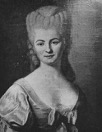
Nicole Lepaute was a French astronomer considered one of the "best astronomical computers" of the time. Her first studies were on the movement of pendulums of different lengths. In 1758, she made predictions about the return of Halley's Comet and determined how the gravity of the planets can affect the path of a comet. In 1762, she calculated the exact time of a solar eclipse that would occur in 1764 by making a map of the extent of the eclipse throughout Europe, with intervals of 15 minutes.
Weight is the force with which any object is attracted due to the acceleration of gravity, acting on the mass of the object. According to Newton's Second Law:
p = m . g
Where p is the weight (in Newtons, N); m is the mass (in kilograms, kg) and g is the acceleration of gravity (which is 9.8 m/s2 on Earth, approximately).
On other planets or satellites, the weight of objects varies if the mass of the planets or satellites is different (greater or smaller) than the mass of the Earth.
If gravity in Mercury is, approximately, 0.39 times the gravity of the Earth and in Jupiter, 2.55 times, calculate the weight of a 5 kg cat and a 1.200 kg car on Earth, Mercury and Jupiter.
Observacions i context
- This activity can be framed in mathematics, within the topic of proportionality or as a complementary activity in the classroom.
- It can be tackled, in turn, in the subject of physics and chemistry.
- She comes from a long line of female astronomers: Enheduanna (c.2285 BC), considered the first female astronomer in history, Hypatia (c.370-c.416), Sophia Brahe (1556-1643), Maria Cunitz (1610-1664) and Maria Winkelmann Kirsch (1670-1720). She was a contemporary of figures such as Margaretha Kirch (1703-1744), Caroline Herschel (1750-1848) and Émilie du Châtelet (1706-1749).
- She was a predecessor of great astronomers and scientists such as Amelie Harlay de Lalande (1768-1832), Mary Fairfax Greig Somerville (1780-1872), Maria Mitchell (1818-1889), Mary Adela Blagg (1858-1944) or Jocelyn Bell Burnell (1943-).
- She worked alongside mathematician Jerome Lalande, who emphasized the work of women astronomers throughout history.
Descripció
We will work on proportionality to predict our weight in Mercury or Jupiter.