Sappho Painter
Personajes:
Tema: Pottery of ancient Greece
Competencias
Competencia en Comunicación Lingüística
Competencia Personal, social y de aprender a aprender
Competencia en conciencia y expresiones culturales
Materias y cursos por Sistema Educativo
España > Cultura Clásica > 3º ESO > Continuidad del patrimonio cultural. Literatura, arte y ciencia
Enunciado

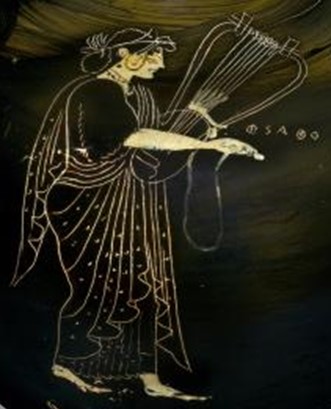
The so-called Sappho Painter was a Greek vase painter in the late 6th century BC. As with other painters whose identity we do not know, he was given this name after one of his works, a hydria depicting the poet Sappho playing the lyre, now in the National Museum in Warsaw (Inv.142333).
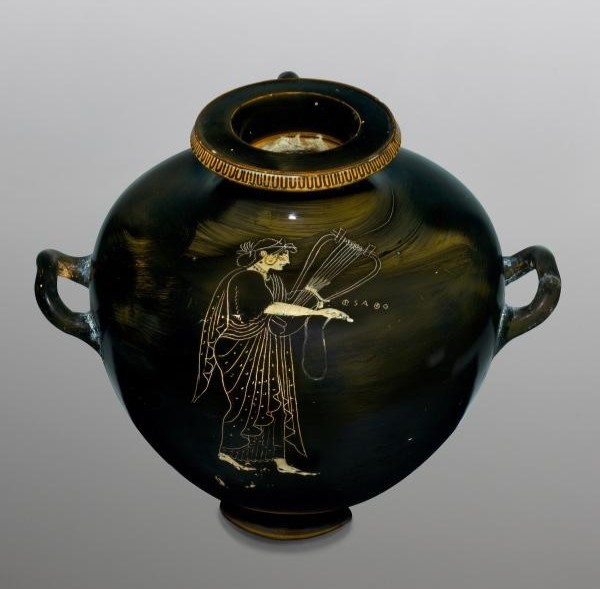
This is a two-part activity. In the first one, we will do some research on Greek pottery; the second one is a practice workshop.
1- Look up information of pottery in ancient Greece online and answer the following questions:
a) What was a hydria used for? What is its defining characteristic?
b) Draw the outline of a hydria and five other Greek vase shapes, writing their name and their purpose.
c) Explain the difference between the painting techniques in pottery: red-figure pottery, black-figure pottery and white-background pottery.
d) You can see the red-figure technique on a hydria from 440-430 BC in the Archaeological Museum of Athens, which also depicts Sappho. Find a picture of the hydria online and describe how the poetess is depicted.
e) Sappho Painter is also the author of several epinetrons. Do some research in this type of pottery and why it is part of the funerary objects found in the graves of some women.
2- In some poster board, draw the outline of a hydria, as big as possible, and cut it out.
-Paint the basis, the handle and the neck of one of the hydrias using a black marker. You can do some ribbing on the base and the neck if you wish. In the middle part, draw or trace the figure of Sappho playing the lyre and then retouch the lines with a thin brush or a black marker. Do not forget to write Sappho's name in Greek, capital letters, just as in the original.
-Paint the other hydria entirely with wax crayons (Manley crayons) and use a pointed wooden stick (a skewer stick will do) to make incisions using the scratch technique, so that the orange at the bottom is visible. Place the sheet of paper with the drawing of Sappho in the middle and go over the lines with the wooden stick. The drawing will be slightly marked on the black. Remove the sheet of paper and go over the marked lines again so that the orange comes out.
Observaciones y contexto
Sappho's example served as a stimulus for almost all the surviving poets of Greco-Roman antiquity, from the Greeks (Mirtis and Corina, from Boeotia; Telesila and Praxila, from the Peloponnese; Erina, from the island of Telos; Mero, from Byzantium; Anita, from Tegea, a modest village in Arcadia? ) to the Romans (Melino, the elegiac Sulpicia, Herenia Procula, Sulpicia the satirist, the travellers Julia Balbila and Cecilia Trebula, Fabia Aconia Paulina, the last pagan...). Romantic writers used it as a shield to validate female authorship (Gertrudis Gómez de Avellaneda, Carolina Coronado, María Rosa Gálvez, etc.). With the contributions of the papyri found at the end of the 19th and 20th centuries, Sappho was once again translated and read.
This is a two-part activity, a first one to do some research on the topic and a second one consisting of a practice workshop to learn the difference between the painting techniques. The materials needed per group will be: two A3 size orange poster boards, pencils, black markers, wax crayons, scissors, wooden scratching stick, photocopy of Sappho playing the lyre.
-This activity can be done individually or in pairs.
-It has been thought for 3rd of ESO, but it can be adapted to other levels.
-To make the activity easier, we can work on only one of the painting techniques.
-It can be developed with the art department.
-It can also be done using other ceramic pieces featuring women doing things as a reference.
As for the so-called Sappho Painter, his pictorial line has been identified on 95 pieces of pottery. Most of them are lekythos, but there are also other vessels and even some epinetrons, a ceramic piece used for spinning wool.
In terms of painting techniques, he is one of the so-called black-figure painters, although in the present work he uses a variant known as the Six technique, in which figures in white or red appear on a black surface, emphasising the details so that the black shows through them.
Descripción
We will study the pottery of ancient Greece using Sappho Painter as a basis. We will work on researching information, obtaining data and artistic expression.