Egeria’s travel agency
Personatges:
Tema: Geography
Competències
Competència en Comunicació Lingüística
Competència personal, social i aprendre a aprendre
Competència en consciència i expressions culturals
Matèries i cursos per Sistema Educatiu
Espanya > Cultura Clàssica > 2n ESO > Arrels clàssiques del món actual. Marc geogràfic de Grècia i Roma
Enunciat
In groups of 4, prepare a travel package based on the route followed by Egeria, a Hispano-Roman lady
born in Gallaecia in the 15th century AD, highlighting some of the Holy places that Egeria passed
through. Once done, you will present it and the group will vote on which trip they like the most.
Starting point: Gallaecia.
Part 1: From southern Gaul to northern Italy.
Part 2: Cruise through the Adriatic to Constantinople.
Part 3: Jerusalem, stop in Jericho, Nazareth or Capernaum.
Part 4: Egypt, visit of Alexandria, Thebes, the Red Sea and Mount Sinai.
Part 5: Antioch, Edessa, Mesopotamia, the Euphrates River and Syria.
Part 6: Constantinople and return home.
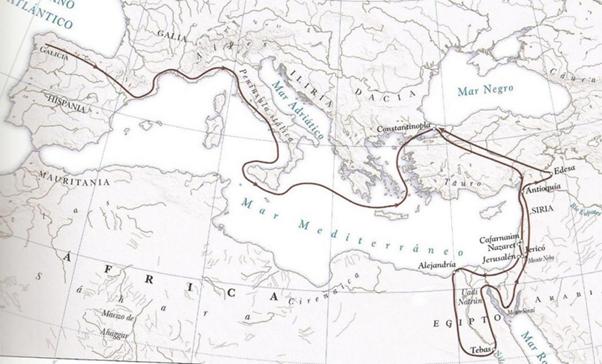
https://www.laviajeraempedernida.com/wp-content/uploads/2015/10/ViajeEgeria.jpg

Observacions i context
Since Empress Helena and Empress Eutropia, mother and mother-in-law of Emperor Constantine, travelled to Jerusalem to recover and repair the Holy Grounds, pilgrimages were common for wealthy classes, including women. Melania the Elder, Paula of Rome or Melania the Younger had biographers who described their travels, but the originality of Egeria lies in the fact that she was the one to write her own diary. Egeria herself writes the immense satisfaction she felt when meeting the deaconess Martana.
After her, the medieval chronicles tell us about the pilgrimage to Compostela of numerous women. In the 12th century, Bona of Pisa made pilgrimages to Compostela up to nine times as a guide for pilgrims, and Gilberga of Flandes brought the original "Codex Calistinus" with her, from Rome to Santiago. In the 14th century, Bridget of Sweden and Queen Isabella of Portugal travelled there as well. In the 15th century, Margery Kempe visited the main holy places of Christianity. The tale of her travels is an important part of her book, The book of Margery Kempe (ca. 1436), a work considered to be the first autobiography in English.
Descripció
Through the figure of Egeria, we will delve into the journey she made.