Vibia Sabina, the power of an empress
Personajes:
Tema: Vocabulary related to power
Competencias
Competencia en Comunicación Lingüística
Competencia Plurilingüe
Competencia Personal, social y de aprender a aprender
Competencia en conciencia y expresiones culturales
Materias y cursos por Sistema Educativo
España > Latín > 4º ESO > Latín y plurilingüismo
Enunciado

The empress Vibia Sabina, a woman of great influence and power, turned the court into a big cultural centre, attracting many musicians and artists. She was a much-loved woman.
This task has been planned for Spanish. Students could be provided with rules for the Latin> English translation and asked to translate into English. The following link is an example that could be followed:
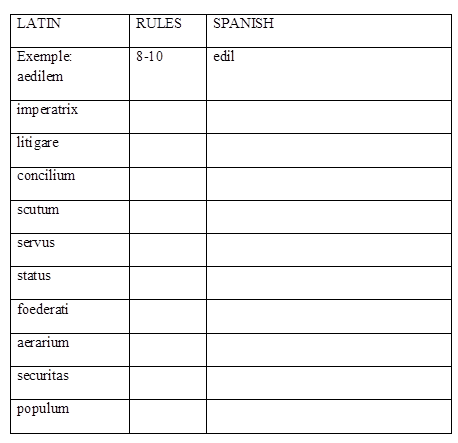
Try to find out the Spanish term based on the Latin word using the following list of vocabulary related to power. In order to do so you can use the following rules of phonetic evolution:
1) The final m disappears; patriam = patria (homeland)
2) The final u becomes an o; templum = templo (temple)
3) The stressed short o becomes ue; bonum = bueno (good)
4) p (or pr or pl) between vowels becomes b; capram = cabra (goat)
5) t (or rt, or tl) between vowels becomes d; mutare = mudar (change/mutate)
6) c or q (or cr, or cl) between vowels becomes g; securum = seguro (sure)
7) Intervocalic d and g usually disappear; cadere = caer (fall)
8) The Latin diphthongs ae and oe become ae; taedam = tea
9) The stressed short e and o become ie, e and ue; térram = tierra (land)
10) The final e usually disappears; florem = flor (flower)
11) The -li- group + vowel can become j. Exemple: foliam > hoja (leaf)
12) Pretonic vowels usually disappear; aperire > abrir (open)
13) The ns group simplifies to s; ansam = asa (handle)
14) Internal postonic vowels disappear; nóbilem = noble (noble)
15) The group c'l, g'l or t'l become j; oculum > ojo (eye)
16) initial s + consonant becomes es; statuam = estatua (statue)
17) Double consonants are simplified; passum = paso (step)
18) The short Latin i becomes e; timere = temer (dread)
Observaciones y contexto
The role of the empresses of the Antonine dynasty was not as visible as that of the Julio-Claudian dynasty, but they were the ones who legitimized the power of their husbands by granting it as a dowry. Plotina, Marciana, Matidia the Elder and Sabina held a public status and represented a series of private and domestic roles with public significance. Later, the Faustinas participated in politics: Faustina the Elder issued coins and promoted the education of women in Rome, and Faustina the Younger was the first empress to receive the title of mater castrorum, as Julia Domna of the Severan dynasty would later do.
Descripción
Using the rules of phonetic evolution, we derive words related to power.