Eternally young eyes
Personatges:
Tema: Sensory organs
Competències
Competència en Comunicació Lingüística
Competència Matemàtica, en ciència, tecnologia i enginyeria
Competència en consciència i expressions culturals
Matèries i cursos per Sistema Educatiu
Espanya > Biologia i Geologia > 1r ESO > El cos humà
Espanya > Biologia i Geologia > 3r ESO > El cos humà
Enunciat

The eyes are organs that enable one of the senses most used by human beings: vision.
These organs have receptors capable of capturing light and sending these light signals to our brain, which integrates them and converts them into images.
As the years go by, our eyes stop working as well as we would like them to, due to various wear and tear factors. The leading Spanish scientist Flora de Pablo has developed a therapy to prevent neurodegeneration of the retina, which could be the key to curative therapies for our eyes. In order to develop this therapy, she founded the company Proretina Therapeutics.
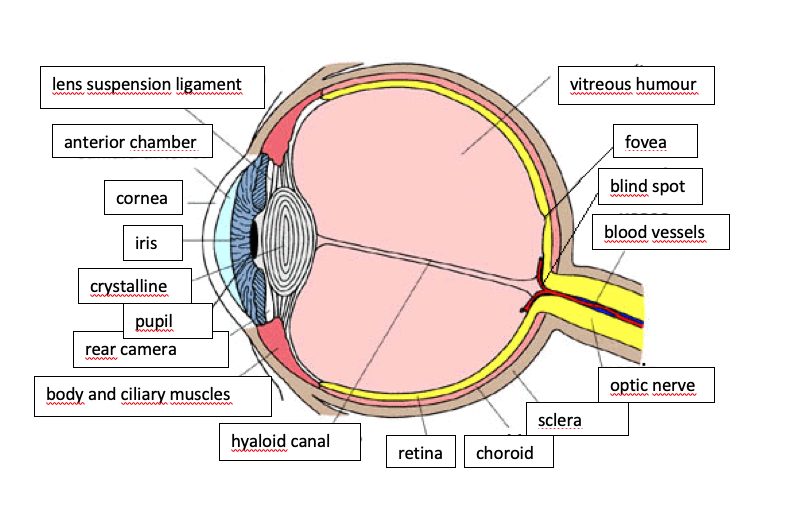
1. Identify the retina in the image and describe the function of this layer of the eye.
2. The technique for maintaining our eyes developed by Flora de Pablo is based on preventing neurodegeneration of the retina: what type of cells do you think will form the retina?
3. Relate the cells you identified in the previous question to one of the systems that form human beings, and reason why neurodegeneration of these cells can be a serious problem.
4. Flora de Pablo's research has been linked to other neurodegenerative diseases that are very important today. Name at least two neurodegenerative diseases that could apply these types of therapies if they were properly developed.
5. Cataracts are also a vision-impairing disease caused by clouding of the lens of the eye. Reason whether the therapy developed by Flora de Pablo could also be a cure for cataracts.
Observacions i context
Flora de Pablo is a contemporary of many other women researchers who have worked on and developed healthcare procedures, such as Teresa Gonzalo Lázaro or Luisa Torsi. They have in common not only their health-oriented research, but also their entrepreneurial nature, which led them to seek solutions to put their discoveries into practice and bring them closer to society. Pilar Mateo Herrero, known for having developed a resinous paint to control Chagas disease.
Other contemporary scientists are: Carmen Fenoll, professor of plant physiology, Alicia Calderón, physicist involved in the discovery of the Higgs Boson, Elena García Armada, creator of the bionic exoskeleton called Atlas 2020, or Mara Dierssen, expert in neurobiology and pharmacology, considered to be at the forefront of international research.
A forerunner of scientific research in Spain is Margarita Salas (1919-2019), who initiated the development of molecular biology in Spain. The history of biology and the natural sciences has been littered with women researchers since ancient times.
Descripció
Activity on the anatomy/physiology of the human eye, with short questions.
The aim of the activity is to reinforce knowledge of the parts of the eye, relating them to its physiology and the problems that neurodegeneration of the nervous system can cause in its functioning, an important aspect of Flora de Pablo's research.
Flora de Pablo's research can serve as a starting point for working on the anatomical/physiological aspect of the eye.