The feminine agent suffix -trix.
Characters:
Theme: Main prefixes and suffixes. Identifying the main prefixes and suffixes of Latin origin.
Competencies
Competence in Linguistic Communication
Multilingual Competence
Personal, social and learning to learn competence
Competence in cultural awareness and expressions
Subjects and year by Educational System
Spain > Latin > 4th ESO > Latin and plurilingualism
Enunciation

Viria Acte was born in Valencia Edetanorum, current Valencia, ca. 90 AD. She was an outstanding woman who, being a former slave, became a successful entrepreneur. She was the owner of a statue workshop that she run herself and that became very prestigious. She received many compliments and honours due to her work and her contributions to the city of Valencia.
She is not the only woman that we are aware of. Epigraphy has allowed us to know of many other women from the same period and others, what they did and where they were born or lived. They are spread throughout the Hispanic territory.
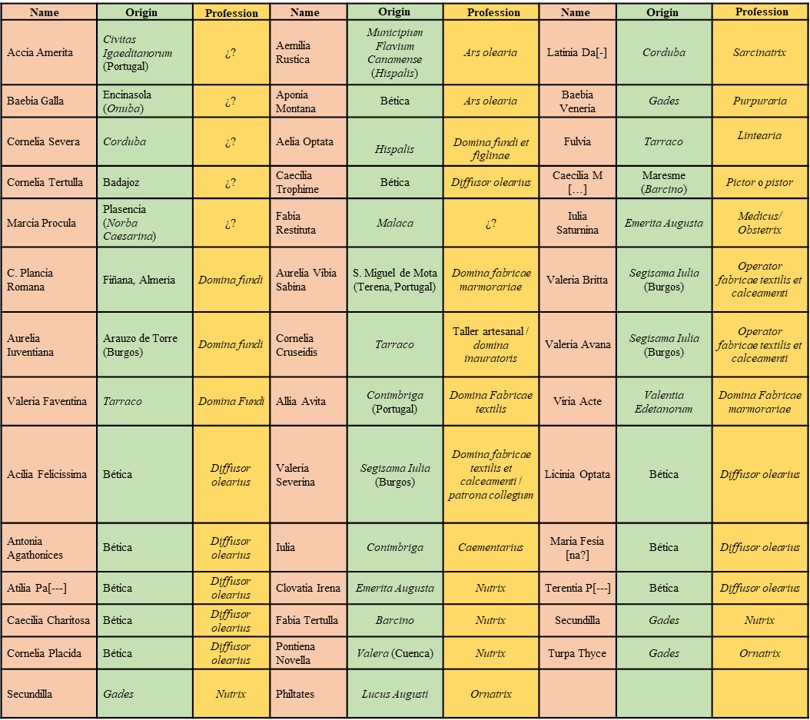
1- Using the information given in the table, extract all professions containing the suffix -trix and copy them.
TABLE
2- What activity does each one of them refer to? To answer this question, check the table below.
PROFESSIONS
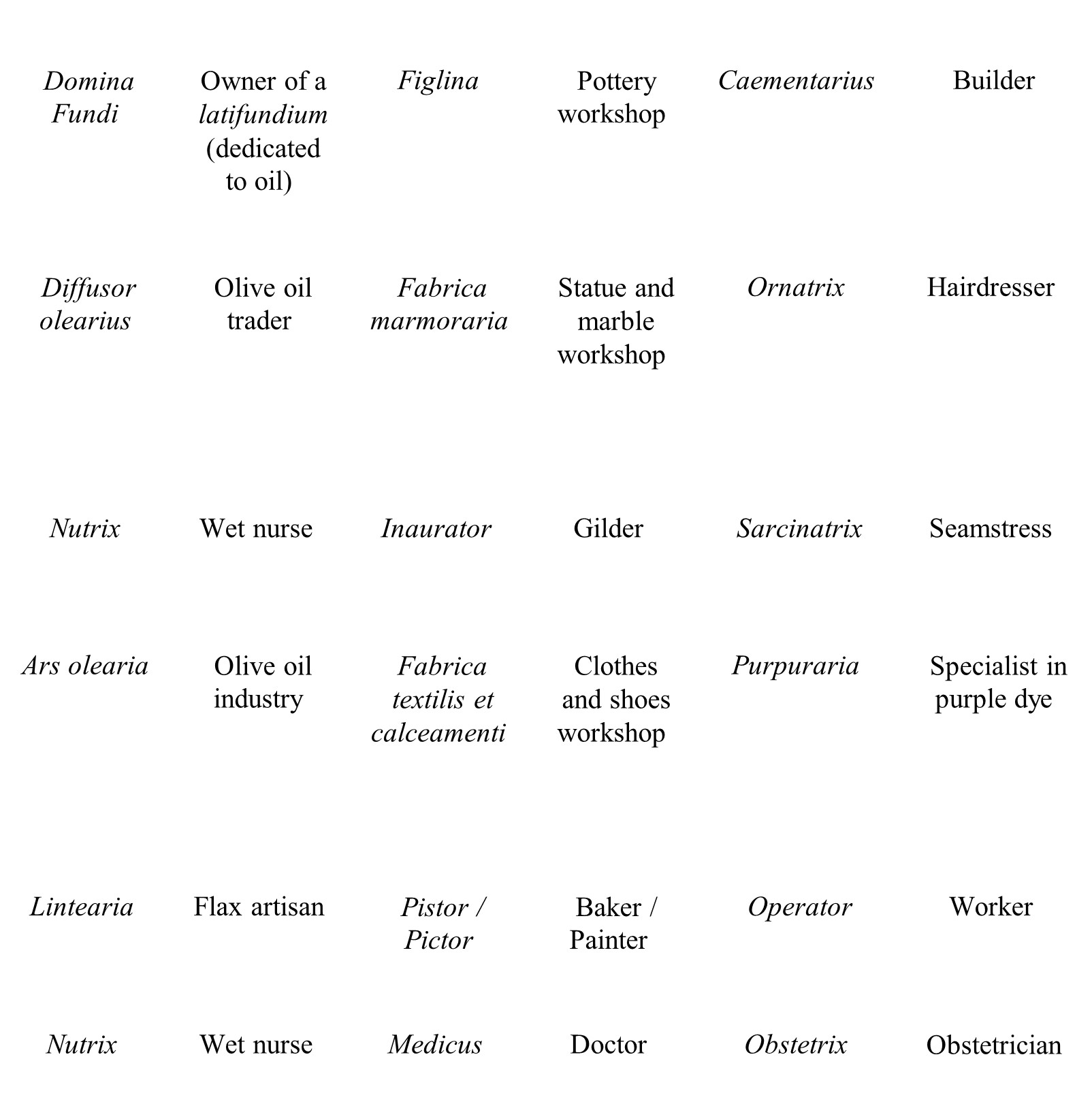
3- Keeping in mind that -trix is the feminine version of -tor, answer:
- What would be the masculine form of sarcinatrix and ornatrix?
- What would be the feminine form of operator, pistor and pictor?
ATTENTION
The suffix -tor is used for creating masculine agent nouns, that means that it is used for the one who carries out an action. Our language has a similar one: -er or -or. The suffix -trix is used to create feminine agent nouns. In English, the suffix -trix is mostly dated, and it is more common to find words ending in -ess with a similar meaning.
4- Find some other English words ending in -ess.
5- Match the columns.

6- What words from the previous exercise are not the feminine version anymore of their corresponding masculine, but have a complete different meaning?
7- Find the definition of those words and write them down.
Observations and context
1- Observations
Viria Acte was a Hispano-Roman woman from the 2nd century AD born in Valentia, in Tarraconensis. There are many more women spread throughout the Hispanic territory that we are familiar with because of epigraphy. Epigraphy gives us several examples of women in the working world during this period, characterized, amongst other things, by women being able to manage their own money and resources. Those jobs and professions are used a base for this activity, in which we will study the feminine agent suffix -trix.
This activity has been thought for Latin in 4th of ESO, in the Block Latin and multilingualism, where mechanisms of word creation and evolution of Latin terms are studied.
2- Context
One of the key factors which led to the greater independence of Roman women in the Imperial period was their ability to own and manage their own money.
The epigraphy of Roman Hispania in the 2nd century offers numerous examples of professions carried out by women who were also, in some cases, owners of their own businesses. To cite just a few names, we can find wet nurses (nutrices), such as Secundilla (Gades) or Clovatia Irena (Emerita Augusta); hairdressers (ornatrices), such as Philtates (Lucus Augusti, Lugo) or Turpa Thyce (Gades); menders (sarcinatrices), such as Latinia Da[.... ] (Corduba); professionals related to the production, dissemination and trade of olive oil, especially in Baetica, such as Accilia Felicissima, Caecilia Charitosa, Cornelia Placida or Caecilia Trophime, among many others; owners of land in production, such as C. Plancia Romana (Fiñana, Almería) or Aurelia Iuventiana (Arauzo de Torre, Burgos); owners of artisan workshops of all kinds _from gilding, textile and footwear workshops to the manufacture of marble pieces, like our Viria Acte _, such as Aurelia Vivia Sabina (domina fabricae marmorariae) (Terena, Portugal), Cornelia Cruseidis (domina inauratoris) (Tarraco) or Valeria Severina, who was also patroness of the guild, (domina fabricae textilis et calceamenti) (Segisama Iulia, Burgos) to women who practised medicine and obstetrics, such as the Hispanic Julia Saturnina (Emerita Augusta) or later women, such as those belonging to other times and places, Primila, Empiria and Venuleya Sosis, qualified as medici; Salustia Ateneis, obstetrix; Naevia Clara, medicaphilologa or Aurelia Alexandra Zozima, cited ‘for her medical knowledge’.
We also find other professions: caementarius (bricklayer): Iulia (Conimbriga, Coimbra); purpuraria (manufacture of purple): Baebia Veneria (Gades); lintearia (weaver or linen merchant): Fulvia (Tarraco); pictor or pistor (painter or baker): Caecilia M [...] (Maresme, Barcino), etc.
Description
Studying the feminine agent suffix -trix and identifying it in English. Creating words from Latin etymons and the suffix -trix.